Thursday, 27 February 2014

How Marvel Films Can Stay Ahead: An Open Letter

Even the most successful superhero films risk losing momentum

Dear Marvel,

There’s no disputing that you’re currently in the lead when it comes to live-action films. You’ve smashed the box office and given Marvel fans something to gloat about. The thing is; DC doesn’t see this as a defeat- even if Marvel fans think it is. They see it as a challenge; one that, if rumours are to be believed, they might just meet.

Last month I wrote an article listing some of the ways I felt that DC could pull ahead of the competition, so it seems only fair that I do one on what you need to do to stay ahead of DC.

The scariest villain we never cared about.


Change it up

So you’ve had a few films leading up to The Avengers, and then... BAM! THE AVENGERS!

It was a pretty successful business model.

But here’s the problem; do something too many times, and it becomes stale- especially if DC does the exact same thing just as well. So keep us on our toes, try not making your single-character films lead-ups to the next Avengers. Try making Avengers 3 right off the back of Age of Ultron. Keep your system varied, and you will surprise your pundits. Trust me, the worst thing you can do at the moment is let this thing get stale.

When the cast for Avengers 3 looks like this, it's
time to stop.
Know when to stop

Indiana Jones was awesome... for three movies. Star Wars was awesome... in the original trilogy. Even Harry Potter started to get a little silly after the third film.

And let’s not even get started on Rocky.

There will come a time when you need to stop creating Avengers films so much. As great as Robert Downey Jr was in Iron Man, you were wise to call it quits after Iron Man 3. Can I go so far as to suggest that perhaps we don’t need an Ant Man 2? That, maybe, you don’t absolutely have to have Guardian of the Galaxy 2? Maybe you do, but will be a time when you need to quit, or at least tone it down for a while. 
The box office is a fickle place, true believers.
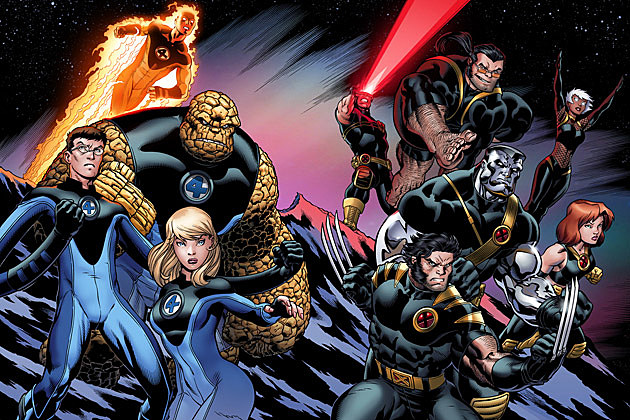
Remember these guys? They need help too.

Help Fox and Sony

Okay, it should be clear that you are NEVER getting your X-Men franchise back. Spider-Man? Not likely, buddy. And don’t even try getting your hands back on The Fantastic Four. But that doesn’t mean you can’t push them in the right direction. Send Matt Fraction as a consultant for FF. Get Dan Slott to give his two cents on Sony’s Spidey script. Let Brian Michael Bendis discuss the X-Men with Fox. I know, you’ve got this Avengers thing going now, but you have a lot of prodigal sons to look after. So care for them!
It’s not just because you want to look after your franchises though. Those of us whose memories go back before 2008 remember that there were some pretty awful Marvel movies out there. For every Iron Man, there was a Daredevil. For every Thor, there was a Spiderman 3. For every Avengers, there was a Fantastic Four: Rise of the Silver Surfer. You’ve had a lot of Marvel based movies made, but- and let’s be blunt- not all of them were box-office smashes. There has been a considerable amount of X-Men: The Last Stand and Elektra’s out there.

Yeah, Elektra. Wanna talk to me about how bad Green Lantern was again?
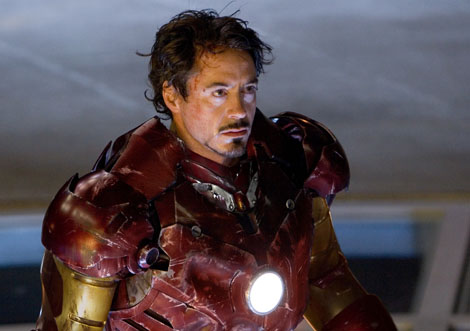
Tony Stark is blown away that The Avengers don't need him.


Let Iron Man be finished

Again, Marvel, Robert Downey Jr. makes a great Iron Man, but four movies later I know I’m getting a little sick of him.

Thing is, his presence in The Avengers kinda usurped the impact of all the other characters. It was Robert’s movie and the others were just in it. Don’t make that mistake with Age of Ultron. By all means use him. By all means give us a couple of witty quips, but if you cop out of Iron Man 3’s ending by giving having Tony Stark construct a new suit because the Avengers “need him” (hint: they don’t they have a WWII hero, a god and a furious rage-monster), you are gonna leave us with a bad taste in our mouths.

Okay, so that’s hardly an exhaustive list, but they’re things that need to be considered. You’ve set up a very competitive environment, Marvel, and we thank you for that but DC’s not going to roll over and die because you put out a couple of good films. You still need to up your game, because I guarantee you, DC is.

Best wishes,


Tom Fulcher

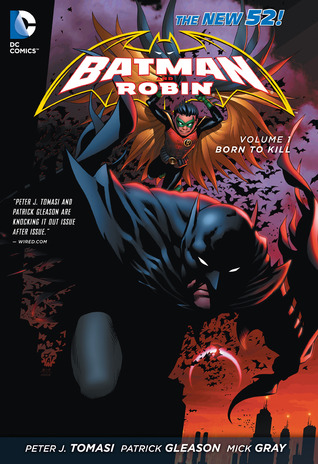
Batman and Robin Vol. 1: Born to Kill (The New 52) Review

Batman and Robin Vol. 1: Born to Kill (The New 52)

There is nothing- NOTHING you can
do to make that logo look cool.
Writer: Peter J Tomasi

Artists: Patrick Gleeson and Mick Grey

Collects: Batman and Robin #1-8

Background Information:

Before you dismiss this title, let me assure you of one thing: this has absolutely NOTHING to do with the awful 90s movie Batman and Robin- they aren't even using the same Robins (the one in the movie is now Nightwing; y’know, the super-cool dude who had surely had nothing to do with the Bat-nipples/crotch).

This Robin is Batman’s son, Damien Wayne. Damien in the son of Bruce and Talia Al’ Ghul (daughter of Ras Al’Ghul) which makes for a family more messed up than anything you’re likely to see in The Simpsons. Damien has a severe little prince syndrome coupled with an innate desire to kill everyone he doesn't agree with (gets that from his mother).

Damn, now I want a Batman version of The Simpsons.

Review:

On its surface, Born to Kill looks like any of the multitude of Batman titles out there, which makes it sound like you could dismiss the book without missing out on anything. But that would be doing yourself a disservice. Though Born to Kill doesn't hit all the marks, it’s definitely one of the better bat-titles out there.
So Damien is a sadistic devil-child who has the potential to turn very dangerous and Batman really hopes he doesn’t. Things get complicated when a guy by the name of NoBody tries to take Damien in as one an apprentice of sorts. What follows for Damien is a Luke Skywalker-style story where his is forced to choose between unleashing his inner sadist or becoming the hero he dreams of being.

The lights never work at the Wayne household... NEVER!
Okay, so a few things to say about characterisation; firstly, the whole story is peppered by these great moments where Bruce Wayne tries his best to be the father he thinks Damien should have. He gets him a dog, and wishes that he could just spend a day playing ball with his boy. It’s hard to do fatherhood right in the superhero genre; like marriage, being a dad ages a character. Somehow, though, writer Peter J. Tomasi manages to hit Bruce in just the right places to make him entirely relatable without losing the maturity that fatherhood forces upon you.

Damien is a decent character here, but there are better versions of the fourth (or fifth, if you’re picky about Stephanie Brown) Robin out there. Damien works best when he doesn’t get what he wants. Being hamstrung is meant to allow Damien to be at his wittiest and somehow Tomasi doesn’t really let that happen. We get a Damien who is innocent (to a degree), and a Damien who is angry, but never one that makes you laugh due to the extent of his frustration. This Damien isn’t bad, but he’s far from the best version of the character.

Finally, NoBody here has an amazing backstory that hearkens back to Bruce’s training before being Batman. It makes for this great, three-dimensional character that I wanted to see more of. Unfortunately, that isn’t likely considering how this book ends, but I honestly loved this take on not only a new villain, but a part of Batman’s history.

The characterisation here is mostly good, but unfortunately, the subject matter of Born to Kill is more than a little overdone. Damien’s hero vs. killer struggle is one that has been played out in books like Grant Morrison’s Batman and Son. It’s starting to look like the only story Damien has is about his mother issues with Talia Al’Ghul. It’s entertaining, but hardly a new direction for the character.

He didn't leggo my eggo...
Art here is as dark as you would expect for a book about the Wayne Family. Different-coloured light works Batman, but Gleason and Grey pull off with aplomb here. The book also feels like it truly has its own artwork, and it manages to stand out among the rest of the Jim Lee-styled artists that DC tends to employ.
well here, and helps to accentuate the darkness that Damien is battling. Character designs are also good here. Damien looks young, Bruce looks like a dad- something that Greg Cappullo never bothered with in

Though Damien could have been fleshed out better here, Born to Kill is hugely entertaining. It gets a four out of five bat-simpsons.

****

+ Bruce is a real father

+ NoBody feels fleshed out

+ Art is dark and distinctive

- Damien is underutilised

- Does Damien do anything other than fight his past?

Alternate Option: Batman Incorporated: Demon Star

If you want another Damien book, read one by his creator, Grant Morrison.

Tuesday, 25 February 2014

Does Source Material Matter?


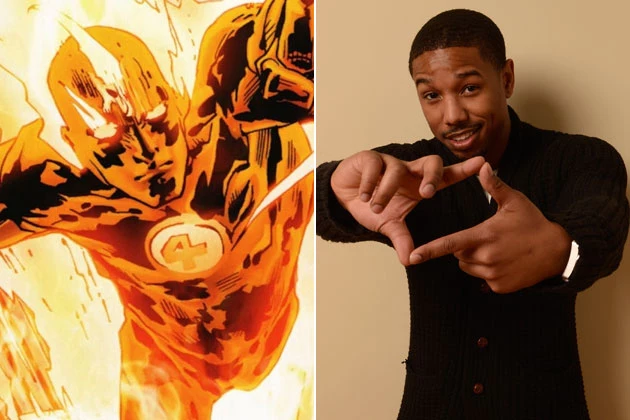
Michael B. Jordan- your new Human Torch
So last week saw the release of the new Fantastic Four Film’s cast. And it was pretty well received.

What?

What’d you say?

OH! That’s right; apparently there is a black dude playing Johnny Storm (AKA Human Torch), a guy who’s always been portrayed as white in the Fantastic Four comics.

IGN, in particular, has valiantly tried to defend this casting choice, pointing out other white characters who were given black film counterparts, and asserting that the character would be just the same if he were black. Sadly, though, there’s no pacifying a group of angry nerds, who claimed that Fox should have just stuck to the source material (I should note, though, that there has been less uproar about this than there was about Ben Affleck playing Batman).

Which got me wondering; when it comes to comic book films, how close does one need to be to the source material? I would argue that diverting from the source material for comic book movies is actually okay- in fact, it’s generally a good thing! Below are a few reasons why;

So much story, so little time

Most of the more popular superheroes have been around since at least the sixties. That gives characters like the X-Men, Batman, Superman and Iron Man a history of at least 50 years! What’s more, unlike books, which finish once the series ends. Comic characters have had their stories going for decades with no sign of slowing down.

So when you ask Warner Bros, Fox, Sony, or even Marvel Studios to pick the “actual” story for their characters, what are they going to say? Is the “actual” Batman story Detective Comics #27? “No, not without the Joker”, you’d say. Is the “actual” Avengers story in Avengers #1? “Avengers with no Captain America? No SHIELD? What are you smoking?” you’d ask. Everyone has their own ideas as to what stories define these characters. The only thing filmmakers can do is capture the spirit of these stories and somehow find elements that appeal to everyone.

So much in the Characters

There is only one Indiana Jones. There is only one Bilbo Baggins. There is only one Luke Skywalker. Comic characters, on the other hand, have been rebooted, retconned and repurposed for at least five decades! Nick Fury was once white; now he’s Samuel L. Jackson. Superman was originally designed to be an evil dictator of a far-away planet; now he fights for truth, justice and the American way. Deadpool was designed to be serious- I’m not even joking!

The characters in comics have changed so much over the last century that even trying to stay “true” to the character is difficult. You want the real Batman? Which one; the comedy one that DC tried putting in the comics, the Frank Millar Dark Knight, or the one from the 40s who carried a gun and had no qualms shooting people? Granted, there is always one prevailing interpretation of a charcter- usually the most contemporary one, but that hammers home my point about how these characters change to suit the needs of the creators. Maybe, for example, there is a legitimate, artistic reason for making Human Torch a black guy. I don’t know; I haven’t sat in the production meetings. But characters get repurposed a lot in comics and so long as we get a reason instead of “that’s the way it is- deal with it” I’m pretty sure we’ll be fine.

Comic book movies Re-interpret- they don’t “adapt”

If there’s one word I think needs to be banned when talking about comic book movies, it’s the word “adaptation”. People seem to be continually mistaking it for “word-for-word transition from print to film”. A better word for comic book movies would be “re-interpretation”.

See, that’s what these films do; they re-interpret stories. It’s essentially a screen reboot of your favourite characters. That’s why the X-Men wore black in their first movie. That’s why Bane was just a muscle-bound dude and not a druggie. That’s why The Avengers never featured the Hulk dressed as a clown juggling elephants as per Avengers #1 (side note: the circus he was juggling in called him a robot because that’s apparently less weird that green giant).

Understanding that, why is a black Johnny Storm any less viable than a white one? Granted there’s the family issue that I’m not sure will be resolved (the invisible woman Sue Storm is white), and I’m not going to go full idiot and claim that it’s one step close to diversity in comics (we aren’t doing a black character in his own film yet, after all). But we need to understand that these movies aren’t going to just regurgitate the comic story back at us- every comic book movie is a reboot, and if they make this new Johnny Storm interesting, who cares what he was in the source material? It hasn’t stopped us before.

Monday, 24 February 2014

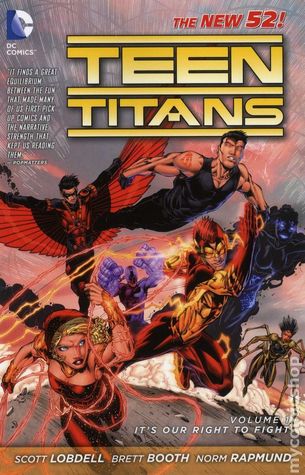
Teen Titans Volume 1: It's Our Right to Fight (The New 52)


Teen Titans Vol. 1: It’s Our Right to Fight (The New 52)

Superboy was luckily smart enough to
dodge the logo.
Writer: Scott Lobdell

Artists: Brett Booth and Norm Rapmund

Collects: Teen Titans #1-7

Background Information:

Who would have guessed that a comic featuring all of the sidekicks from the DC universe would take off in such a big way?

Yet ever since the 80s, the Teen Titans have continued to pull a major readership. In recent years, the team roster has changed a lot, but DC seemed to have settled on four major characters that are always on the team: Robin, Superboy, Kid Flash and Wondergirl.

Review:

Not surprisingly, the New 52’s Teen Titans takes a lot of cues from the now-cancelled Young Justice cartoon. This is a darker setting than those used to the Teen Titans cartoon of last decade are accustomed to. Yet, while Young Justice made their roster of teenage sidekicks take on a life of their own, Lobdell’s take on Teen Titans fails to take advantage of a great group dynamic and ultimately, this book comes across as little more than a poor-man’s Justice League.

It’s Our Right to Fight’s plot follows a very X-Men like structure. All over the world, teenage “meta-humans” are popping up and making themselves known. A shadowy organisation called N.O.W.H.E.R.E , which has possibly the most complicated acronym ever, are after all of them for shadowy reasons. Enter Tim Drake, a.k.a Red Robin, whose goal it is to gather all of the meta-teens he can to resist N.O.W.H.E.R.E and their ambiguous attacks. As Drake puts this team together, N.O.W.H.E.R.E releases their counter-measure to try and stop Drake and his new friends: the test-tube meta-teen Superboy.

I should make it very clear here, that only Red Robin ever admits to having been a superhero’s sidekick. The other characters have pretty much sprung up out of nowhere. And that’s fine. In fact, the team dynamic is strong in Teen Titans. As a group, they work together better than Geoff John’s Justice League did on their first outing. Most of the characters have strong, distinct personalities, as well. Kid Flash is cocky and arrogant, Skitter (cross between the Hulk and a weird bug creature), is militantly uninterested in joining a team, and Wondergirl is brash and headstrong. The only weakness in the characterisation here is Bunker, the gay Mexican who somehow manages to embody every cliché connected to both minorities. Go figure, the guy who wears and wields purple stuff is the gay character. Bunker also refers to himself as “fabulous” and dresses like a fashion designer. He uses Spanish interchangeably with English while seeming to assume everyone knows what he’s talking about, and regularly mentions how much his small Mexican village is nothing compared to American cities. Lobdell thankfully salvages the character by making him the glue that keeps the team together, but were it not for that, Bunker would be a step backward for comic diversity.

But Bunker isn’t the real problem for the Teen Titans. Lobdell’s written some excellent character here and they definitely have potential, but his poor choice of story content hurts what could otherwise be an amazing collection. Throughout this volume’s seven issues, it feels like very little actually happens. It’s a problem that isn’t made better by the book’s non-ending that leads right into The Culling crossover event, which left me feeling like I had given up on the series after reading a few issues.

The art here is not bad by any means. Booth manages to capture the emotions of the Teen Titans perfectly and Rapmund’s inks are impressive. The problem, though, is that Teen Titans ends up looking like every other DC book on the market. Some really stand-out art with its own unique style might have served to compensate for a storyline that felt rather pointless. Unfortunately, even with really good sameness, the art in It’s Our Right to Fight failed to distract me from the fact that I just wanted the Teen Titans to take those great personalities and that amazing team dynamic and do something more interesting with it.

Ultimately, though, it’s about as hard to recommend It’s Our Right to Fight as it is to completely discredit it. Lobdell has made a great team here, but it’s a team who seems to be doing very little. This collection gets a two and a half out of five gay stereotypes.

+ Amazing team dynamic

+ Very likeable characters

- Not much happens

 - Bunker relies on too many stereotypes.

Alternate Option: Justice League: Origin

As much as many have loved to beat this story up, I still found myself enjoying it more than It’s Our Right to Fight.

Friday, 21 February 2014

Fan Film Friday: Red Birth

Considering how popular Green Lantern comics have become, and how poor the associated film was, you would have expected a lot more GL fan films around. Instead, this is the first one I've seen, and it's for the Red Lanterns.
 
But hey, it's always fun to watch a guy spew napalm on a jet, so enjoy!
 

Tuesday, 18 February 2014

Should My Child Read Superman?


Since the Great Depression, Superman has always been a role model for humanity.
The following article was written by me to be published on Where The Books Are.

As a Father, reader, and English teacher, I take great interest in my children’s reading. I want them to both read and learn from great books not simply as escapism, but also as tools for emotional learning. I hope as my kids read, they will be able to see not only the good in the characters they read about, but also the good that they can achieve as human beings.

I’m also a huge comics fan. I absolutely love the stories that come out of Marvel and DC, and find the artwork refreshing and immersive. And if it so be that my kids enjoy comics, fantastic (I am, in fact, suspicious that my three-month old son is kinda’ getting into Justice League).

Although it’s often tempting to think so, those two modes of thought are not at odds with each other.  Reading narratives is all about learning certain life lessons (irrespective of whether the author meant to put them there or not- there’s a whole scholarly school of thought about it), and that happens regardless of whether a child is reading Shakespeare or Superman, Whether it’s Austin or the Avengers, whether it’s Tolstoy or Transformers.

What I’m NOT Saying

Before I go on too much. Let me make something really clear. I’m not, let me repeat, not saying that you should go and buy your child a comic right now and get your child to read them exclusively. Children and adults should read broadly. Even though I believe comics have the ability to teach life lessons that we sometimes think are exclusive to novels, people in general need to learn these lessons from as many different sources as possible.

I’m also not going the other way and dismissing books in favour of any other kind of media. I’m not suggesting that what can be done with a book can be done with, say, a movie, or a TV show, or a video game. Books and comics, in my view share one very important trait- they allow us to stop. When we read a narrative in print, we can give ourselves time to put it down and think deeply about what message is being sent to us. In taking the time to think about the theme a printed narrative presents, we are able to form our own opinions on it and grow as human beings. Screen-based media doesn’t offer us the same opportunity. They present us with the message and then move straight on to action scenes or that final kiss. There is little time to think about it, little time to process what is going on. Yes, we can pause the DVD, but we’re hardly encouraged to as we watch. Printed media is far more likely to give us that opportunity.

What I am saying is that if your child is reading a comic- and this is the important part- DON’T FREAK OUT! They’re not denying themselves the ability to learn valuable lessons, it’s simply that the method of teaching has been altered slightly.

What are they learning?

The cop-out response is that many comics raise questions over what it means to be great or, let’s say; heroic: Is someone a hero because of their physical abilities or because of their character? The answer is usually in the latter, but this example is a little vague for my liking. To really explain my point, I’d like to refer to my two favourite comic series to date.

If I had to pick an absolute favourite comic series, it would be DC Comics’ Nightwing written by Kyle Higgins. As a child, Nightwing was better known as Robin, the boy sidekick to Batman. When he grew up, he took on a new identity and spent a lot of time forging his own path. What strikes me about this character is that unlike Batman, who uses intimidation and is often written as emotionally disconnected, Nightwing is a genuinely nice guy. He has no problems with telling others that he cares for them and is best known for his shows of empathy. He’s also an alpha male- physically strong and able to overcome a great many obstacles. I love the idea here that being a nice guy is not opposite to being masculine- you can be both. Is that something I want my son to understand? You bet. Is that something I aim for? Absolutely!


Another one of my favourite titles is Marvel’s All-New X-men. In this one, Cyclops, the former heroic leader of the X-men has turned more or less evil as the result of many years living in an unideal society. As a result, a younger Cyclops is pulled forward in time to remind the modern anti-hero of how far he has fallen from his original ideals. The younger hero is, obviously, far more innocent: he’s seen a lot less of the rough side of life and he still maintains his original peaceful ideas. In essence, this is a book that shows youthful innocence with all of its hopefulness and idealism , as a strength rather than a weakness. It’s a message that I would love my kids to understand when they reach their teens and are thrust into environments where their peers might look down on innocence as a sign that they haven’t “grown up”.

These are lessons that every human being should learn. Can they such lessons in novels? Of course they can! But it would be unwise to assume that novels held a monopoly on life lessons. Good narratives teach good lessons, and if your child is learning that lesson from a comic instead of a novel, all you need to assume is that the lesson is being learnt.

Monday, 17 February 2014

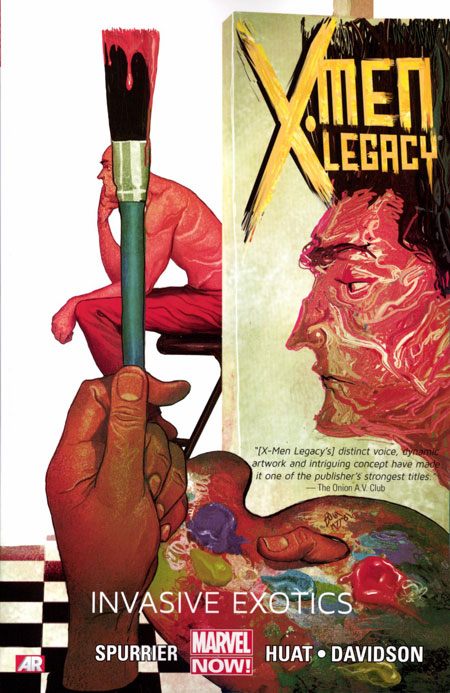
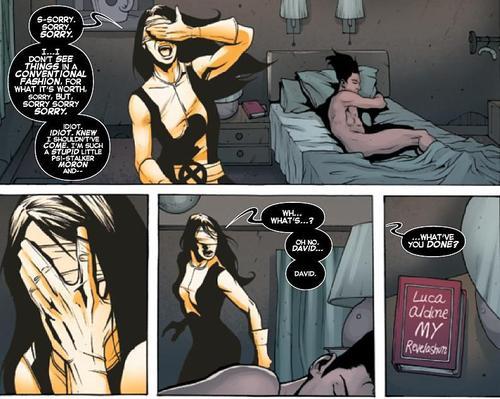
X-Men Legacy Volume 2: Invasive Exotics (Marvel NOW!)


X-Men Legacy Vol.2: Invasive Exotics (Marvel NOW!)

You think he'd be sensitive about the hair...
Writer: Simon Spurrier

Artists: Tan Eng Haut and Paul Davidson

Collecting: X-Men Legacy #7-12

Background information:

The Marvel NOW! version of X-Men Legacy focuses on the mutant known as Legion (although, he’d rather be known as David). He’s the mutant son of Charles Xavier, now-deceased father figure to the X-Men, and he is possibly the most powerful mutant in the world.

Legion has multiple personality disorder. That’s fairly uninteresting except when you consider that each one of those personalities is a very powerful mutant. Each time one of those personalities takes control, a new superpower manifests itself. On the flip-side, each one of those personalities is a dangerous sociopath. In the last volume, Legion was slowly gaining power over each of these personalities. He also made the decision to help mutantkind in a less-militant way.

Review:

Invasive Exotics was a book that I thought I was going to hate by the time I was halfway through reading it. Then the book’s final arc was told and suddenly I was in love with X-Men Legacy all over again. Spurrier writes a slow book, one that was absolutely made for trade rather than single issues, but it’s one that rewards the patient reader by bringing all of those slow moments together in a way that feels like it matters.

So let’s talk about that slow beginning. By now, Legion has decided to tackle mutant oppression in his own special way, and that means firstly, finding out what Luca was all about in the previous volume. This leads him to a cult known as the church of the happy host. Which he takes apart fairly easily. That’s the first issue of this volume, the second sees legion trying to come up with ways to help a young boy named Santi. Santi is a mutant with the power to take the credit for every good dead ever done; a fireman rescues a family, Santi gets the credit. A cop busts up a burglary, Santi gets the credit. I like the idea here that there are mutant powers that have nothing to do with combat, but there didn’t feel like there was much in this story.

In fact the first three issues in this collection are painfully boring. Gone is the great criss-cross between Legion’s mental prison and the real world, which was one of the best things about the previous volume. The stories themselves plod along at snail’s pace and there is very little here that can excite the reader even that fantastic art looks less spectacular here as Haut and Davidson are forced to draw pretty mundane environments that lack the chaos of the previous book. There’s no energy in these stories, no drive at all.

Then Spurrier delivers the punch that is issues 10-12. It’s in these issues that the previous issues of the collection make sense as a whole. Legion seeks out a group called Darwin’s Martyrs, who have developed a “cure for mutant-ness”. I know, it sounds like X-Men 3, but here it’s actually done well. Legion wants the cure. He knows about how his life is going to end and wants to stop it by removing his powers for good. I can’t go on much further than this without ruining the story completely, but it makes you realise that those wading-through-mud first three issues weren’t just fillers- they were part of a cohesive plotline that rewards you for trudging through the boring bits of the book.

Invasive Exotics is a complex book that suits Legion’s own complexity rather well. The first half of the book is sluggish, but it rewards you for your patience. It gets a three out of five dangerous sociopaths.

***

+ Patience is rewarded.

+ Some interesting concepts introduced.

- First half of the book is dull.

- Art limited by dull locations.

Alternate Option: X-Men Legacy: Prodigal

The better of the two Legacy volumes, this one takes the time to get us acquainted with Legion’s multiple personalities.