Showing posts with label Marvel. Show all posts

Wednesday, 3 August 2022

Pointing out Pixel F***ery: Why it's okay to blame Marvel for what Marvel is doing wrong.

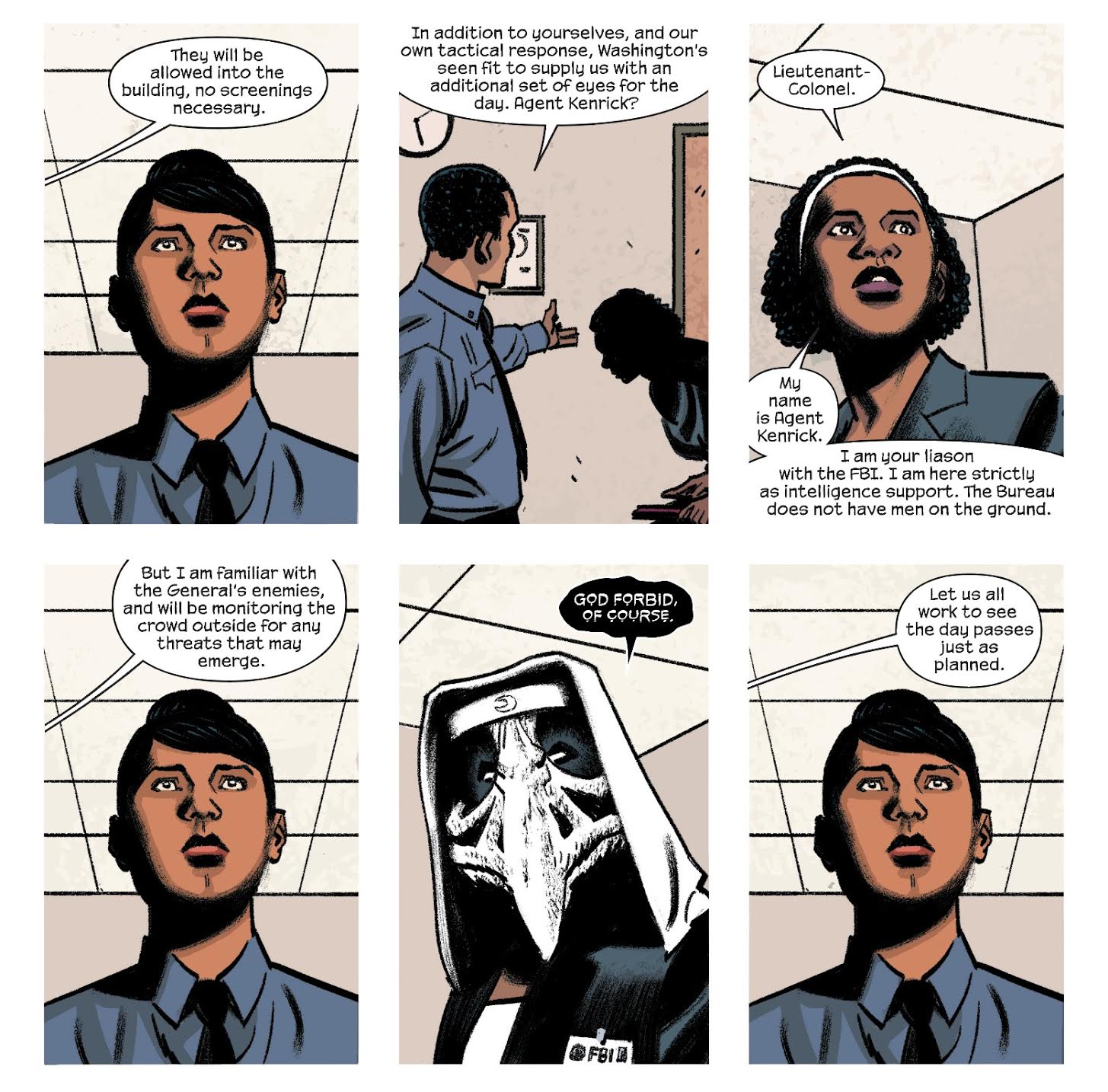
So the internet did the totally normal and not Stockholm-Syndrome-y thing this week when Vulture published this article last month describing the poor treatment of VFX artists by Marvel studios. Written by an anonymous contributor, the writer remarks that:


The response from most have been appropriate: they have called it a terrible working environment and have called on Marvel Studios to change.

Then... there are the others.

Others like this:


and this:

and this:


And look, dear thought leaders of film twitter, you're probably right. This, in broad terms probably is a much bigger, industry-wide problem. But let's not treat this like the good faith argument that it poses itself as. Yeah, it's totally okay, even right, to point the finger at Marvel here.

Let's start with the claim that this is an industry-wide thing and not just a Marvel thing: it's true, but it's true in the same way that Anti-Semitism not just being a Nazi thing is true. A problem being widespread does not mean that the most egregious offenders are suddenly not something we need to worry about (I also suspect that were this not Marvel Studios, the problem would suddenly limit in scope to these people, but that's pure speculation).

And make no mistake: Marvel is at least presented as the most egregious offender here. The writer in the article remarks that: "Where I would usually have a team of ten VFX artists on a non-Marvel movie, on one Marvel movie, I got two including myself. So every person is doing more work than they need to." They further state in their conclusion that "Not every client has the bullying power of Marvel".

And this isn't necessarily because Kevin Feige is sitting in his industrial revolution-style movie factory, beating the children who don't make the machines work and rubbing his fingerless-gloved hands in glee whenever the working class is oppressed. The writer cites the way that Marvel puts out heaps of movies with inflexible release dates and hires directors with little to no experience with effects-driven filmmaking as key components of why working with Marvel is so hard, but these are things that are VERY specific to the way Marvel does things. I'm not saying Marvel is the only one to put undue stress on the way that VFX artists do their job, but they certainly seem to be the worst at it. And why should we not focus on the ones who are doing the most damage? If I have a grazed knee and a bullet wound at the same time, I would want the bullet wound taken care of first because it would be causing the most pain. Why should Marvel not change when they are the ones with the most bullying power?

But a bigger problem here isn't that Marvel are doing the most damage- it's that they've been so successful in the process. No less than ten Marvel movies have earned over one billion dollars. Their model for filmmaking and storytelling has been one that every other studio has tried to ape over the last decade. They have been praised as industry leaders. It's safe to say that no other studio has as much influence over the industry as Marvel has- or it's at least safe to assume so.

And this is how they got that influence?

I know what some will say- that they actually got that influence from telling good stories with compelling characters- but none of those stories would be possible without the work of talented VFX artists who make Iron Man fly, Captain America's shield ricochet off of mooks and Thor's hammer crackle with lighting. Hell, they've even made hotel rooms for movies like Spider-Man: Far From Home. For a key part of Marvel's success to be thanks to these kind of working conditions sets a disturbing precedent. It says to other studios that this is what you need to do to play with the big boys, and we can't just assume that other studios won't follow that example. I called Marvel and industry leader, maybe it's time they showed some real leadership.

And this isn't some argument against VFX artists unionising, by the way. Rather, I hope that when they do unionise, they aren't afraid to take industry giants like Marvel to task. I don't really have a snappy way to end this post, except to say that when things are wrong, they are wrong- even when they're your favourites.

Wednesday, 1 August 2018

Inhumans Vs X-Men (ANAD Marvel)

C'mon X-Men, why can't you die off
like a good little non-MCU property?
Writers: Charles Soule and Jeff Lemire

Artist: Javier Garron

Collects: Inhumans Vs X-Men #0-6

Background Information:

Y’know, I get the feeling that years ago, someone told Tom Brevoort that if you kick the X-Men down the stairs, they make funny noises. Since the beginning of Marvel NOW! in 2013, the X-Men have been getting the absolute snot kicked out of them by the Avengers, other humans, other mutants, and the hand of fate. And by the time Inhumans Vs X-Men came around, everyone at Marvel editorial staff were yelling “WHAT THE HELL! Why isn’t anyone laughing yet?”

It’s almost as if the X-Men were owned by a movie studio that had no connection to Marvel and Marvel are bitter that the children they sold into slavery aren’t coming home to dinner!

Oh, wait. They were. And Marvel are.

Review:

Seriously, how does this NOT look like a villain to you?
Or at least, they have been up until last week when Disney bought Fox and all of the X-Men and Fantastic Four characters that came with it. I can’t wait for people to find out that the Fantastic Four are a team that comic fans like only on principle and that the X-Men were already done nearly perfectly in X-Men (2000), X-2, First Class, Days of Future Past, The Wolverine, Logan, Deadpool and Deadpool 2. That’s right, folks, Fox made more movies that X-3, Origins and Apocalypse!

But I digress. My point is, the acquisition of Fox by Disney is something I’m sceptical of. But there is one silver lining: now that Disney can exploit the X-Men like Chinese children in a shoe factory, we might be rid of events like Inhumans Vs X-Men; a book designed to kick the X-Men down as far as they can go so that Marvel can promote an MCU property.

A lot of the plot of this book began in Death of X and you know what? I quite liked Death of X. It was a solid mystery book with a final twist that was well set-up. In that one, the world became convinced that the X-Men are baddies because they destroyed a cloud of poison that affects only them and gives Inhumans their unremarkable powers. Yep, the Mutants became the bad guys because they’d rather not be poisoned. 

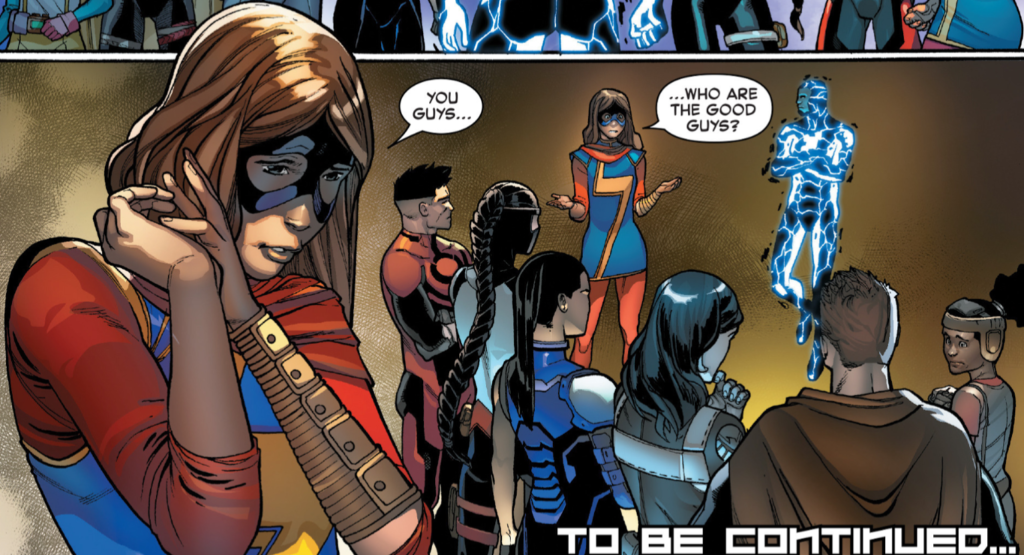
I can answer that question, Ms Marvel, but you won't like
it.
And on that note, in Inhumans Vs X-Men, the X-people have decided that in order to have enough time to deal a second poison cloud, the Inhumans have to be put out of commission for a while. So they lock the Inhumans in hell. And I’m pretty sure that this is what Marvel thought was all that was necessary to convince us that the X-Men were the baddies here. “Hell?” they seem to say “You know who lives in Hell? Satan does and do you know what Satan is? A BADDIE!” to which the rest of the world, who have just watched Lucifer says “Are you sure? He seems rather charming and that’s without the ‘trying-not-to-die’ angle.” And Marvel then sticks their fingers in their ears singing “LALALALALA”.

Oh, wow it's... you know what? I don't
care.
Now I’m someone who believes that event book should contain all essential elements to the story in the event itself instead of in numerous tie-ins. I believe this because I have limited funds like the rest of humanity and my brain is still functioning. Marvel however, seem to think that most of its audience have made it big on bitcoin. As a result, some key parts of the story- parts that are essential to understanding what the hell is going on- are relegated to tie-ins. As a result, the majority of this book left me wondering things along the lines are “How did they know this?” “Where did these characters come from?” “How many more pages before I take a bath with a toaster oven?”

The art here is just good. It shows everything happening, it’s just a pity that the things happening just aren’t very interesting. It represents a missed opportunity for artists because the potential for awesome panels in a book where the Inhumans and X-Men really go all out in combat, but most of the book is either the Inhumans trying to get out of hell, or the X-Men trying to figure out how not to die. I know people blame Civil War for being action-light, but it’s a roller-coaster compared to this one.

Overall, this book is exactly what it sounded like when the event was announced; a marketing ploy to direct us from one product to another. It’s a shameless MCU advertisement designed to make us like the Inhumans more than the X-Men. The problem? At the end of the day, you’re likely to hate the Inhumans more that you ever did. It’s like every time Miley Cyrus is allowed in a recording studio. It gets one out of five toaster-oven baths.

Thursday, 7 June 2018

Secret Empire (Marvel) Review

Honestly, though? Most of theses
characters aren't in this book!
Writer: Nick Spencer

Artists: Andrea Sorrentino, Steve McNiven, Mark Brooks and Daniel Acuna

Background Information:

2017 was the year Marvel shot themselves in the foot more than barefooted man in a needle dump. Inhumans Vs X-Men was all about how evil the X-Men were for being gassed by the Inhumans- a claim that sounds a lot like blaming the twin towers for being in Al-Qaeda’s flight path. Various men over 38 complained that Thor was wearing lipstick and Captain America….

Oh, Captain America.

Review:

Captain America post Secret Wars was turned by Spencer into an agent of HYDRA. This pleased absolutely nobody. So-called “SJWs” hated the change because a character with a Jewish creator was now a Nazi and the “anti-SJW” community hated it because OF COURSE the straight, white, cis character was a Nazi because that’s what pop-culture does these days! That dedication to upsetting just about everyone continues in Secret Empire, which seems dedicated to driving away the last dregs of the Marvel fandom that still exists.
Remember how Marvel is supposed
to be the colourful one?

You know a book has a problem when the title bears no resemblance to what actually happens in  
 
the book. See, a secret is a fact or reality that is deliberately hidden from the public, whereas empire suggests a group of nations that is under the control of one larger, more powerful nation. Pay attention to that as we have a look at the plot of a book that is actually called Secret Empire:

The recently Hydrafied Captain America takes over the USA- and JUST the USA- and then makes everyone aware that Hydra is in charge by BLOWING UP WASHINGTON DC! So, Marvel, if this isn’t particularly secret and also not quite an empire, why are you calling it Secret Empire. Is it because you wanted to bank on the word “secret” that you’ve used in Secret War, Secret Warriors and Secret Invasion? Is it because the word “empire” sounds more like the kind of word used to describe the baddies than “kingdom” or “government”?
And how they had consistent art?

I mention this, because Secret Empire is a book that feels as though it’s more about PR than story. The book tries its best to put the focus on the new legacy characters- not because Marvel has any clue what to do with them (the characters do precious little in the story despite being given a huge chunk of page space), but so that Marvel can parade them around like so many Hollywood celebrities with Ugandan orphans. It’s more about how Marvel appears to the general public than where Marvel are going with the two years of monthly storytelling since Secret Wars.

I’ve heard rumblings amongst the community that Secret Wars is meant to be some scathing criticism of the Trump presidency. I for one am quite fond of Trump criticisms, but if Spencer wants this to be a Trump criticism, he’s absolutely failed at it. Before he got into power, Trump could be most charitably described as “not Hillary Clinton”. Captain America was considered to be an American hero by literally everyone. Furthermore, Cap is able-bodied, brave and intelligent! The only similarity between the two is the fact that they’re both terrible choices and there’s no way that’s enough for the metaphor to work!

And how that art was always interesting?
Nick Spencer isn’t by any means a bad writer. When he’s writing upbeat, humorous books such as his work with Ant-Man and The Superior Foes of Spider-Man, it’s pretty clear that he’s in his element. Secret Wars isn’t an upbeat book though, and Spencer seems to have no idea what to do with it. Most issues he starts out writing relatively dark dialogue which at worst is boring, but then something snaps in his head and he realises that if there isn’t a joke, he’ll likely develop a brain tumour. So he puts in the first joke that comes to his head, which is usually gaudy and instead of the issue just being boring, what we get is an issue that is painful.

If you don’t like to know the ending of books, stop reading now. I would call this a spoiler, but I get the feeling Spencer “spoiled” things enough since the beginning of the new Marvel NOW. One of the biggest kick to the teeth is the way that Secret Empire resolves itself. When HydraCap first started, Spencer insisted that this was the 100% real, cross-his-heart-hope-to-die Captain America. By the end of the book, however, we find out that HydraCap in fact isn’t the 100% real, cross-your-heart-hope-to-die Captain America and that the real version was inside the Cosmic Cube all along. Someone needs to tell Spencer that there is a difference between misdirection and flat out lying and that what he did was definitely the latter!

Actual footage of Nick Spencer in private.
I feel bad for criticising the artists here, because Andrea Sorrentino (who is one of my favourite comic artists currently in the industry) does at least a third of the art duties, but it honestly the worst Sorrentino art I’ve seen to date. Now, as I just said, Sorrentino is an excellent artist, but he’s an excellent artist when the writer knows what to do with him. When he’s working with Jeff Lemire, for example, you get a book that highlights just the right part of the action and it lends the book a kinetic, visceral energy the best example of which are in Lemire’s Green Arrow and Old Man Logan. In Secret Empire, there’s so little action in the issues that Sorrentino draws that we never get that feeling of primal brutality that makes him such an interesting artist.

The other problem is that this is an event book. Event books need big, colourful, artists who work with a sense of grand scale and that’s not Sorrentino’s wheelhouse. As such, the better art in this book comes from the other THREE ARTISTS. Each of these artists, though, have very different styles and as a result, nothing in this book feels like it belongs in the same story as anything around it, like a heroin dealer at a christening.

It’s been a long time since I’ve review a book this big and an even longer time since I spent this much time reviewing a book. But honestly, I keep finding things I hated and really nothing I liked outside of the artwork. It gets one out of five PR projects.

Wednesday, 11 April 2018

Death of X (ANAD Marvel) Review

Death of X (ANAD Marvel)

Writers: Jeff Lemire and Charles Soule
Artists: Aaron Kruder and Javier Garron
Collects:  Death of X #1-4

Background Information:

You know, for a company awash with "SJW" politics, they certainly like to let their non-mutant heroes beat up their minority metaphors. The Jew- I mean, X-Men- have had their numbers whittled down to two hundred in House of M and all the Avengers did was accept it as the natural order of things. Then they got punched in the face by the Avengers in Avengers vs X-Men because if Captain America didn't attack those uppity black peo- I mean, X-Men- they'd probably keep evilly disarming nuclear weapons and cruelly bringing water to drought-stricken areas (seriously, that's what they do in the book). At this point in my reading, I'm about to enter the Inhumans vs X-Men event where you can pretty much count on the Inhumans beating up the LGB- I mean, X-Men. At this point, you can colour me surprised if we don't get a Power Pack vs X-Men event where the team made up entirely of kid-appeal characters get to beat up the Musli- GAH; X-men!

Review:

In case I was being too subtle, let me make something very clear: I do not want Inhumans vs X-Men to be a real comic in the mainline continuity. Partially because I'm sick of the Mexic- wait; X-Men-being kicked around so easily when they're some of the most objectively powerful people in the Marvel universe, but mostly because I know this is isn't an event that comes naturally from good story writing. It's about promoting a team that Marvel studios can use in movies over a team they can't. Just like how Marvel cancelled the Fantastic Four because every time Kevin Feige saw it's poster on the wall, he'd start crying and listening to Good Charlotte.

That said, if this is how we have to have this event, I'm glad Death of X is the way we end up with it. It is, (and it's been a long time since I've said this about a recent Marvel book) a decent mini-series. The whole thing deals with the death of adult Cyclops (because we need to distinguish between him and young Cyclops these days). Basically, Cyclops is taking a group of Asia-- no; X-men- to Muir Island where his fellow mutants have been investigating the Terrigen clouds that have been giving Inhumans their powers and Mutants cancer. When they get there, they discover that ever non-MCU character still active in the 616 is now dead and the Terrigen cloud is to blame.

Somehow this all leads to writers Jeff Lemire and Charles Soule trying to convince you that Cyclops was the baddie in all this. See, we're lead to believe that Cyclops wants to destroy the cloud because he doesn't want other mutants  to die whereas the Inhumans want to keep the cloud because they think it's really super special. Juxtaposed against each other like this, it seems like Cyclops has the slightly nobler goal here. Sure the Inhumans see the cloud as sacred, but that seems pretty insignificant that the cloud will LITERALLY POISON ALL MUTANTS! I fail to see why I shouldn't like cheer for the Inhumans, Marvel, and their TV series isn't helping anything!

This could have been fixed by making the Inhumans seem to be some sort of underdog, but Lemire and Soule don't even seem to do that. In the first issue of the miniseries, the Inhumans, lead by Crystal, are talking about how hard it was for humans to accept them, but through diligence and hard work, the humans now cheer whenever they come to their town. On the other hand, the mutants have been hated and feared since the sixties and what kind of message are we trying to send there? See, minorities? If you just tried a bit harder you wouldn't be so oppressed all the time!

As writers, I really like Lemire and Soule so I'll give credit where credit is due. The action here is well-paced. Both writers do a great job of giving us these great moments where the characters use their powers incredibly well. There's also a plot twist at the end of this which is fantastic; partially because you don't see it coming, but mostly because for a good portion of the book, you think that one of the characters is just being written poorly. Then you find and why and I won't spoil it but it is pretty incredible. Despite everything I've just whined about, these elements do make up for them and it leads me to believe that a lot of the problems aren't the fault of the writers as much as they are of Marvel execs trying their best to get people to stop being fans of the Native Ameri- ... you know how this bit works by now.

The art is handled by Aaron Kuder an Javier Garron and it's does it's job. Both artists excel in action scenes and with the support of the colourists, it's these pages in particular that really stand out. It's when you get into calmer moments where character are allowed to show more emotion that it really becomes clear that Garron is the better artists. He's got a talent for making characters emote in ways that are emotionally relatable. Kuder, on the other hand, does something with his characters' eyes that make them look like someone has hit them on the head with a club made of concrete and hallucinogens before letting them speak. Their mouths are in the right positions, but as I was reading I kept having the sneaking suspicion I was about to join a hive mind.

Overall I liked Death of X. At the end of the day, though, it's hard to tell exactly what it is. It's either a last meal for fans before the Inhuman's bullet is put through their skull or it's bait to make us think the Indians- yes, you're getting good at predicting this now- stand a chance in the upcoming event. It gets a three out of five DCEU fans...
...
GAH! X-MEN!

***

Wednesday, 23 August 2017

I won't review: August Edition

Welcome to "I won't review" A short series of paragraphs where I give an overview of books I don't wish to review in depth. Mostly because they're rubbish. It's a new idea that probably won't last into next month.
 
GYAHH!! NEVER SHOW ME THAT SMILE AGAIN!
Amazing Spider-Man 2014- the whole run by Dan Slott
 
There once was a hero named Spidey,
Who said "my best days are behind me.
My marriage is gone,
puberty is prolonged,
and that's why nobody will buy me"
 
One out of five limericks.
 
Waste of a perfectly good Venom


Guardians of the Galaxy vol. 3: Guardians Disassembled by Brian Michael Bendis
 
Okay Brian, here's something to consider. If a month from after reading your book somebody says "Hey, what's Guardians Disassembled about? I need something to fill in the time between sticking my tongue in the toaster and gouging my vitals organs out with a spoon." and I can't tell them what happened, you haven't written a great book. I'm not even sorry.
 
Two out of five vital organs.
 
Nyawww... look at the widdle Thanos!

Guaridans of the Galaxy vol. 4: Original Sin by Brian Michael Bendis
 
I was going to say that my experience reading Guardians thus far has been like an alcoholic swearing he'd never drink again after a rager only to find himself puking all over his hallway the week after. I've got a better one now, though; it's an embodiment of the old idiom "beating the dead horse". Well, except Marvel have not only killed the horse, they've brought it back to life, killed it again have beaten it, brought it back to life again, killed it again and are now trying to figure out new and exciting ways to keep beating it.
 
Two and a half out five horses.
 
Gee, it would be great to have more Fantastic
Four books, wouldn't it, MARVEL!?!?

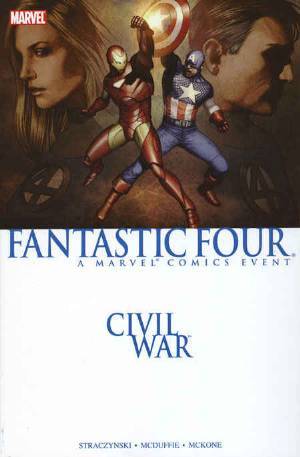
Civil War: Fantastic Four by J Miacheal Straczynski
 
Remember how I said I wasn't reviewing these books mostly because they're rubbish? Well this is the exception: a book that takes actual time and effort in between mindless jokes an dumb action to deliver actual character development and depth. In case the title wasn't clear enough let me drop you a hint: It's a Civil War tie in. And by that I mean the good Civil War. No, not the one where Captain Marvel stole the treatment for Minority Report, that's the bad one. No, not the movie that final answers the "will they,  won't they" question Tumblr's been assuming to know the answer to for years now, that's also the bad one. I mean the one written by Mark Millar and actually dared to suggest that things were actually happening in the Marvel universe that wasn't going to be retconned  by the following Tuesday. The entire FF deal with the fallout of what is basically Sue and Reed's divorce and it goes about a smoothly as you would imagine. That is to say as smoothly as the end to this not-review.
 
Four out of five "will they; won't they" questions.


Friday, 4 August 2017

Old Man Logan (Marvel) Review

This doesn't come close to the amount
of blood in this book.
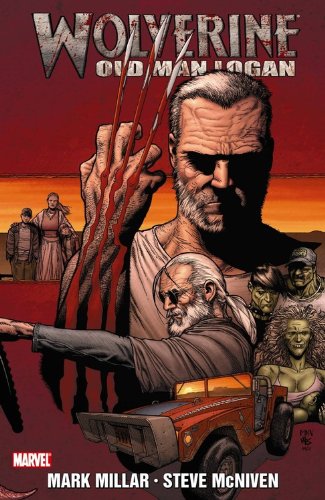
Old Man Logan
Writer: Mark Millar
Artist: Steve McNiven
 
So is this an argument to get rid of the X-Men or to keep them?

Either Old Man Logan shows what awesome stories can be told when all of the X-Men are killed off, or it’s a testament to the awesome stories that can come out of what is, ostensibly, an X-Men book. Either way, I’m surprised that I’m actually writing a review, because if you haven’t read this WHAT IS WRONG WITH YOU!?!?

It’s sometime in the future and everything has gone to hell. The villains have taken over the world, the world is a post-apocalyptic nightmare and every hero in the Marvel universe is either dead or broken.

Wolverine is broken; he hasn’t popped his claws in years, preferring life on a family homestead with the name Logan. When his family find themselves in trouble with the Hulk’s redneck kids (yep, you read that right), Logan puts his hopes on a smuggling run across the US with a blind Hawkeye.

Okay, let’s get the one criticism out of the way: this doesn’t really need to be a Wolverine book. I could picture a Captain America or even a Hulk book being done to this plot without too many major changes. Nobody that is particularly important to Wolverine’s history makes an appearance here (aside from Hulk). We get only a passing reference to other mutants. Jubilee has, what, three lines in the whole book? The supporting cast for the story are otherwise almost entirely new characters save Hawkeye, who, again, could have worked with anyone and nobody would tell the difference.

It gets THIS bloody...
Luckily, Logan isn’t really the star of this book; the world that he inhabits is. It’s a little bit Mad Max, a little bit The Magnificent Seven, a little bit 1984. Villainous America (which, for once, isn’t a new name for the Trump administration… well… not explicitly…) is a bleak and barren landscape. I’ve only ever spent a short amount of time in the USA, but from what I saw, today’s America is geographically diverse and has just as many green places as desert. Not so for this future. Both the east and west coasts are almost indistinguishable from the Nevada. It makes you wonder what on earth these villains did to make the world the way it is. Trying to interpret old Westerns into the modern age doesn’t quite work the way that writer Mark Millar wants it to; everyone but Logan and his family end up coming off as more redneck than homesteader; but the sense of tension throughout in perfectly indicative of a gunfight in a dusty, one-street town. The whole world becomes the most enjoyable part of this book and I’m livid that the All-New-All-Different Old Man Logan ongoing has left that world behind.

... and THIS bloody
That’s not to say that Logan and other characters aren’t well developed. Millar really runs with the idea that the Marvel heroes are completely and utterly defeated. Logan’s reasons for not popping his claws are highly believable. Just as interesting is Hawkeye’s character. He suffers from survivor’s guilt after the supervillains ignore him completely (because, y’know… Hawkeye). In fact, there’s an argument to be made that Hawkeye’s life affects the story of Old Man Logan to a greater extent than Logan’s.

The art here is done by Steve McNiven who also worked on Civil War. McNiven has a way of drawing action scenes that somehow make you feel every punch to the gut. Every stab, slash and puncture comes across with painful kinetic impact. Being the bloody, violent book that Old Man Logan is, this makes the whole story’s emotional impact stronger, honestly, than any other artist would be capable of.

Overall, though, Old Man Logan is an absolute classic. Not to bang out a cliché, but if you only ever read one Wolverine story, make it this one. Nothing else starring the character comes close to this story that gets four and a half out of five redneck Hulk children.

Friday, 14 April 2017

The Difference Between Bullying and Poor Taste

You would think there'd be nothing to hate about this team.
Oh boy.

This month saw the release of Marvel's new RessurXion (is that spelt right? I mean, it's not exactly a word, but...). With it, came X-Men Gold #1, a new team starring favourites like Colossus and Old Man Logan. The issue, to be honest, is quite good- we get a X-Men team that feels more like the well-received Astonishing X-Men than it does Uncanny X-Men.

Sounds great? So what's the issue?

The offending panel
Well, it turns out the issue's writer, Ardian Sayaf, brought in a few too many personal politics. See, X-Men Gold #1 he included a reference to a verse in the Qur'an that, according to some translations, forbids believers from making Jews and Christians their leaders.
Sayaf is Indonesian and right now, the Christian governor (or former governer, not sure), a man known as Ahok, was tried for blasphemy for a misstated comment on the Qur'an. Ahok's comments enraged the Indonesia's 85% Muslim population. Sayaf was obviously upset about this as well, because in

My first thought when seeing this was "how did anyone know to notice the verse here?"  My second thought was "this is possibly the worst comic to include this in."

See, X-Men Gold features a team lead by Kitty Pride; a Jewish woman who has been nothing but upfront about her heritage for many, many years. Let me make  it clear; she is the team leader in a book where the art suggests that people like her should not be leaders. For that reason, and that reason alone, Sayaf should be pretty embarrassed about his artistic faux pas.

In all likelihood, the verse was intended to criticise Ahok, suggesting that Christian was not the best choice for a Muslim nation, and if Sayaf had tweeted the verse with a #Ahok at the end, I 'm certain he would not have faced the same backlash (although, really, if you get political on the internet, don't expect people to leave you alone). The message would have been clear: Ahok should not be, or should never have been Jakarta's governor. In the context of the comic, however, it came off as "I resent contributing to a book about Jewish people". Before anyone jumps down my throat and tells me that I'm making assumptions; I know I am. That's part of what reading entails. But I don't imagine myself to be some great genius and if I'm a total idiot, then I'm hardly alone. If I can take that message out of the book, chances are a few others have as well.

She's Jewish. The verse was a bad idea.
In a past article, I spoke about Marvel's habit of bullying some of their readers into accepting a new status quo or ideology. I don't think that's what is happening here. Bullying has to be targeted and continuous. Someone calling you stupid once is not, for example, bullying. Someone calling stupid over an extended period is. This is the first, and likely the last time Marvel has done something like this. Moreover, Marvel's bullying tactics came from strawmanning an ideology that undesirable, but harmless, into something villainous and idiotic. It was something they did not once, but over and over again and it was certainly more overt than this. It was also unconnected to recent events, but more to a particular "out-group". Sayaf's art bears just about no similarity.

It was, however, in incredibly poor taste; not just because the issue's lead was Jewish, but because recent events (though sparked by the west) have likely put a lot of people who don't know better on edge regarding Islam; well, more so than they were before. The verse could be interpreted as inflammatory; particularly towards a predominately Judeo-Christian country like America.

This poor timing, poor taste and poor use of two letters, three numbers and a colon reflect poorly on Marvel. I feel sorry for him; his intended message seemed a lot more tame than media attention would make it seem. It was a dumb mistake and once he's felt the expected amount of embarrassment, I hope he continues to draw for the comics industry because honestly, his art is good. Marvel have since dismissed him. I think that was the wrong move for a silly mistake that editors should have picked up on. Lets just say that, with the kerfuffles of the last month, my opinion of Marvel as a business is fairly low.

Thursday, 6 April 2017

Diversity isn't killing Marvel- bullying is.

All-New insults, All-Different standards

In a recent interview with ICv2, Marvel's Senior Vice President, David Gabriel, addressed the massive slide in company sales. And to be honest, he really had to. As of the most recent figures in February this year, Marvel only had two books in the top ten comics. Both of them were Star Wars books. To find a Marvel superhero book, you need to get to number 13, where Spider-Man #24 sits. By contrast, DC takes seven of those top ten spots.

So why are Marvel so far behind? It's not like the company's presence isn't felt everywhere you look. Marvel characters are more popular than they've ever been. Regardless, Gabriel's answer has left many unsatisfied, to say the least. According to IGN.com;

Essentially Gabriel said that, according to retailers he talked to and sales data, Marvel's push towards diversity was the reason for the sales drop. "What we heard was that people didn't want any more diversity. They didn't want female characters out there. That's what we heard, whether we believe that or not. I don't know that that's really true, but that's what we saw in sales." Gabriel later elaborated on those comments in an interview with ICv2. There he said, "We saw the sales of any character that was diverse, any character that was new, our female characters, anything that was not a core Marvel character, people were turning their nose up against. That was difficult for us because we had a lot of fresh, new, exciting ideas that we were trying to get out and nothing new really worked."

Now, the IGN article in the link above goes on to say that it isn't diversity that is hurting Marvel's bottom line, but bad business practices; namely, putting out 5USD per issue for series' that have absolutely zero traction (see Red Wolf- what? You forgot who that was? Exactly!). That's a fair point, but Marvel have been pricing themselves out of the market for months before trying the Red Wolf Schtick. Others have pointed to event fatigue, but that's a pretty old chestnut for Marvel and again, it never hurt them before.

I suggest that Marvel's problem is on a creative level, not a business one. No, I'm not saying that making characters diverse is the problem. DC have plenty of books featuring people of colour, women and LGBT+. The problem is more perverse than that.

It's bullying.

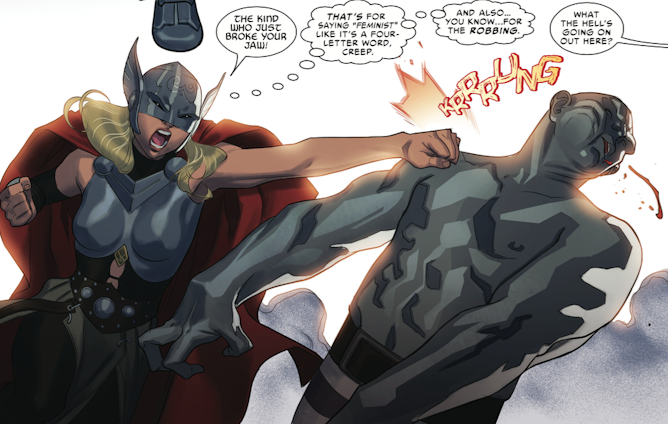
Let me demonstrate. In the early stages of the Mighty Thor, we saw this moment:

And here I am, at the height of "punch a Nazi", posting this.
I must have a death wish.

To some, this was where Marvel  made it very clear that having unfavourable opinions on feminism was worse than an actual, literal felony. I'll admit, I was on board for the new Thor until this happened. Once it did, I wasn't so sure. I have no problem with feminism (though I find it unsettling that the face of pop culture feminism is Anita Sarkeesian- it really should be Liana Kerzner), but this felt mean-spirited and petty. Like it was the author acting out their own fantasies and shaming people who felt uncomfortable with what passed for Feminism in pop-culture.

Last year, we got this from All-New Captain America;
Quick, put them in shadows or we won't know they're evil!


 In case you're not sure, that's the Serpent Society in the background, who have now become anti-immigrant. You can be sure, though, that Sam Wilson dispatched them with extreme prejudice. Again, I am actually pro-immigration (I am Australian, however, and immigration here looks different to what it does on the US border), but even I could see the unfair strawmanning of an opinion that the writer clearly didn't like.

And least you assume that I'm saying that comics need to "be more conservative", this moment from Captain America: Sam Wilson was equally concerning:


Someone actually wrote this as dialogue... and an editor approved it.
On the other hand, it means you can probably achieve anything!
And these panels are only a small sample of some of the more talked-about moments in Marvel comics.

As I said, the problem isn't that Marvel leans left- they and nearly every mass media company in the world has done so for the last fifty-or-so years to relatively little blowback. The problem is that the writers have been given license to routinely mock others and then be praised for doing so. I'm a teacher in a high school as my day job, so I find  myself dealing with reports of bullying from students. For something to be considered bullying, it has to be regular and targeted. Sadly, Marvel seem to be meeting both criteria.

And before people start telling me "objectivity doesn't mean treating all opinions as valid"- let me make it very clear that I'm not saying that it does. What I am saying, very loudly, is that it also doesn't mean giving page space to mocking those ideas. The opinion being put forth by these writers- at least, the one common theme amongst the above examples- is "people I don't like deserve relentless ridicule" followed, according to Marvel, by "and I expect those people to pay me to do so".

Says who?

In my job, we also teach students who are being bullied to leave the situation; that getting away is far better than being violent. How does this relate? Well, readers have been leaving Marvel. And why shouldn't they? Why should readers stay for material that makes them feel like dirt. That's not why we read superhero comics?

I miss these two so much!
So the next question becomes one of alternatives. How do we put forth a political opinion without putting down the other side? Well, there's no simple answer to that and I think pop culture, if they give a damn about their audience, will always struggle with finding the balance and nuance needed to communicate these ideas in a world were 140-word tweets make international headlines. That said, one good example to look at in Christopher Yost's Scarlet Spider. The Kain Parker-lead Spider-Man spinoff was deeply involved with the complexities of the immigration argument. It was unafraid to deal with the risks these immigrants took to care for their families, the challenges faced by illegal immigrants and the horrible situations from which many of them run. But it did so by highlighting those issues- not by making Kain put a stinger through the eye of every white person he ran into. The
X-Men, traditionally, have also been a great way to showcase the struggles of minorities to those who, without the assistance of the superhero genre, have found it hard to sympathise otherwise.

Please note; I have only mentioned Marvel books in the above paragraphs because in the past, Marvel have been excellent at dealing with a range of social issues. Hopefully, the books I've mentioned above are proof that they can be again.

Most comic fans are familiar with Stan Lee's slogan; "Excelsior!" The word is Latin. It means "ever upward". If that's truly the direction in which Marvel wish to travel, they have no space to stoop to lower levels.

Monday, 13 February 2017

Moon Knight Volume 2: Dead Will Rise (Marvel NOW!) Review

How many faces do you think we can fit on
one cover?
Writer: Brian Wood
Artist: Greg Smallwood
Collects: Moon Knight #7-12

Background info:

Marc Spector was shot in front of a statue of the ancient Egyptian god, Khonshu. When he awoke, he had within him the spirit of Khonshu, the charge to become a guardian to all night travellers as Moon Knight and a case of dissociative  identity disorder (henceforth DID, which is a lame acronym). Throughout the years, his DID has manifested itself in different ways. At one point, he thought he was Wolverine, Spider-Man and Captain America. In the previous volume of this run, his personalities have manifested themselves as the vengeful Moon Knight, the more sophisticated Mr. Knight, and Khonshu himself (at least, that's how it appears).

Review (spoilers ahead):

No, this is really a comic
One of the main advantages to Moon Knight's previous volume, From the Dead, was the book's Dead Will Rise, this formula is done away with in favour of a six-issue story arc, and it weirdly comes off as just a good.
structure of multiple stand-alone stories. It was great to see a book that was focussed on telling great stories within the 18-pages of a single issue- something that hasn't really been seen much since the golden age of comics. In

When the ruler of an African country comes to New York, Wahalla, Marc's psychiatrist, sends an assassin to kill him. Marc now must match wits with her not only to save the leader's life, but to keep the spirit of Khonshu. What happens in these pages is the best character development seen in this iteration of Moon Knight.

Brian Wood has taken writing duties over from Colin Bunn, and it's clear that he's built significantly on that solid foundation. Nowhere is this more clear than the relation between Marc and Khonshu. Where the previous volume saw Khonshu standing over an otherwise obedient Marc we start to see real conflict between the two. What is especially interesting is the implication the Marc might not be best choice for Khonshu's powers. Nonetheless, it seems Marc needs the Moon Knight personally.

Just as good, though, is Wahalla's development. She's given a reason for wanting to kill the leader, but Wood goes deeper; giving multiple layers to her hatred. Make no mistake, the good doctor is far from virtuous and credit goes to Wood for resisting the urge to make her a sympathetic villain. When you discover her real reasons for wanting the leader dead, you're well and truly ready for her to be punished by Moon Knight.

So, Moon Knight is a villain, too.
The art has also shifted duties, with Greg Smallwood taking over from now until Secret Wars. Smallwood continues the series style that remains iconic even after the relaunch. The pure, uncoloured white of Moon Knight's costume stands starkly against the darker colours of the backgrounds and supporting cast.

My only problem with Dead Will Rise is that it seems to end WAY too abruptly. I would love to see how this event changes Marc's life and his relationship with Khonshu, but the final issue in this volume doesn't give any hints to it.

Overall, though, this is a strong start for the new Moon Knight team, which earns it four and a half out of five lame acronyms.

Yeah, I DID that...

Okay, a lame pun, too.

**** 1/2

Monday, 31 October 2016

Amazing X-Men Vol. 1: The Quest for Nightcrawler (Marvel NOW!) Review

Okay, fine- you've seen the coolest
image in the book already. HAPPY?!
Writer: Jason Aaron

Artist: Ed McGuinness

Collects: Amazing X-Men #1-6

Background Information:

There was a time when the X-Men fought baddies. Then a few different things happened. Magneto became a good guy, the X-Men split into the Uncanny X-Men and Wolverine's X-Men, and Cyclops found himself convinced that all humans were evil and that mutants had to be protected from them. Now the X-Men fight each other. For better or for worse, Marvel NOW! X-Men have been fighting each other. That's earned it some criticism

Oh, they've also brought the original X-Men into our time from the past.

That couldn't possibly go wrong, right?

You thought I was joking about the "literal hell" part, didn't you...
Review:

In many ways, Amazing X-Men feels like a return to form for those who have come to loathe the Amazing X-Men an exception rather than a rule.
current run of X-books; it features a classic team of mutants, has plenty of humour and, most importantly, is about X-Men fighting someone other than themselves. It's a pity then that Marvel have seemingly no interest in continuing this series into the current X-Men run, and that disinterest shows, making

The Quest For Nightcrawler finds the X-Men in literal hell- That's something only Jason Aaron could make light and fun. They've followed the Bamfs (not an acronym) through an unknown portal with new member Firestar and have been confronted with Azazel- the evil pirate demon-dad of Nightcrawler.

In case you're wondering, yes. This collection was written with no other purpose than to bring Nightcrawler back into the universe, and honestly, it's done fairly well. The fight between Nightcrawler's X-Men (yes; in this collection, that's what they are) and the demon pirates in as fun and bombastic as many remember comics always being. Nightcrawler's action scenes- particularly his fights with Azazel- are particularly epic; seeing him "bamf" around cutting down enemies is exciting and his dialogue feels fresh and witty.

The other characters, unfortunately, don't feel as fleshed out. Firestar (who I know I'm going to mess up and call Starfire at some point) seem's to be relegated to "straight man" to juxtapose Iceman's not-quite-as-funny-as-Aaron-wants them to be, and be shocked at the so-called craziness of everything. Northstar hates everyone and reminds us about why we haven't seen this character since his wedding a few years ago. Beast is FAR better handled in Bendis' X-books as Aaron dilutes his character to being a coffee addict. I could go on, but it bums me out that Marvel are giving us X-books that basically say "you can have well-developed characters or you can have storylines where things actually happen." No, Marvel; we want both!

Guys... don't mean to be a downer, but
Wolverine's in this book, too.
Thankfully, plenty does actually happen in The Quest for Nightcrawler, and for a moment, you're tempted to ignore the fact that none of the characters actually need to be there. This is a story that could just as easily be told with the Avengers or even the Fantastic Four! It's a book full of cool happenings, but nothing more substantial. Is it fun? Sure; and those lamenting the seriousness of contemporary comics will likely love it, but don't kid yourself: this is pretty shallow escapism.

The art here is vibrant and colourful and it makes you think of the 90s X-Men cartoons. I can't stress here just how much this book seems written for those who miss the old X-Men and every visual drives it home. It helps to drive home the fact that this is the "fun" book.

And ultimately, I'm glad it exists. I'm not always a fan of the "light and funny" mandate that seems to get god-status every time a piece of superhero media exists, but Amazing X-Men proves that there are still SO many ways to take the franchise. It's not the deepest mutant book- not by a long shot- but it's a fun, nostalgic read to be sure. It gets a three out of five Bamfs (again, not an acronym).

***

+ Nightcrawler is well done.
+ Vibrant and colourful art.
+ Fun tone with lots happening.
- Character progression nearly non-existant
- None of these characters feel important to the story.

Saturday, 1 October 2016

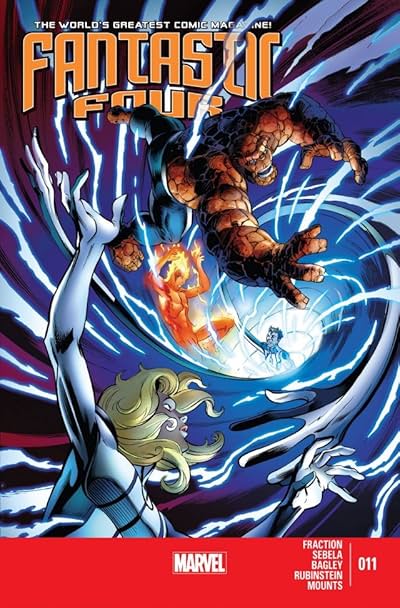
Fantastic Four Vol. 3: Doomed (Marvel NOW!) Review

It's... prophetic... I'll give it that.
Writer: Matt Fraction

Artists: Mark Bagely, Raffaele Ienco, Mark Famer and Joe Rubinstien.

Collects: Fantastic Four (2012) #9-16

Background Information:

For the last two volumes, the Fantastic Four have been trying to figure out what has been messing with their powers.

Oh yeah, it's been killing them, too.

Trying to find a way to fix their problem has involved them travelling through time and space because comics. The family have been to a lot of strange places and found out completely nothing.

Doesn't that just make you desperate for more?

Review:

I don't get it. I just don't get it.

I swear, you'd think Marvel were trying to
tell us something...
You ever read those books that has plenty of what you like and then ended up forgetting about it?

That's Doomed  in a nutshell. At face value, there's nothing to hate- there's even a lot to like- yet, somehow the whole thing is a bore. It's disappointing because as the final volume of Matt Fraction's run, this should have been the best book of the three-volume stint. As it is, it's only the second. It's better by far than Road Trip, but not as good as New Departures, New Arrivals.

So Reed Richards now has to fix his family's powers before everyone dies. On the side, Ben Grimm is worried that his actions resulted in Dr Doom existing, so he and Reed go back in time to witness the beginning of Marvel's greatest villain. There's also an alternate universe that's ruled by Kang the Conqueror, Annihilus and Doom himself, and that takes us to the book's climax. If that sounds overly complicated, it's because it is.

This is one of those volumes that was made after the series was cancelled and, like all comics that suffer the same fate, every remaining issue gets crammed into one volume that makes for a rather cluttered story. The result is that there's really too much here. Or at least it feels that way. Fraction somehow puts that much into a story without ever giving the feeling that something has actually happened.

I'll give it this, where Road Trip felt like nothing more than a transition point, Doomed actually feels like it's about something, but each part of Doomed feels like it's being squeezed out of a pipe (don't make that a poo joke... don't make it a poo joke... DAMMIT, you made it a poo joke). Each moment feels like Fraction was saying to himself "Just one more page, and then I can get back to writing Hawkeye, which I actually like doing" and because of this, I found myself checking how much more of the book I had to read before I could move on to something else.

And at this point, it really is hard for me to believe that Marvel didn't have a plan to destroy the Fantastic Four for no other reason than it couldn't make movies about them. Scream "conspiracy theorist" all you want, but at the end of the day, Matt Fraction is a far better writer than this. Like I said, his Hawkeye is proof enough of this. It really does seem like Marvel was telling him to make this book as boring as he could, and if that was the case, pat yourself on the back, Matty ol' boy because you certainly succeeded- even when you had a million and one exciting things going on, you still pushed out a stinker (you're making a poo joke again, aren't you?!).

Even the black suits didn't help...
The art is the strongest feature of this book. It's really the reverse of the writing. Where the writing had all the hallmarks of a great book and still failed to deliver, the art uses colours that usually would only go together if you wanted to incite madness and somehow still comes off as pretty pleasing. A large part of the credit goes to the pencillers Mark Bagley, Raffaele Ienco, Mark Farmer and Joe Rubinstein, who draw these incredibly exotic, out-there environments. Even so, colourists Paul Mounts and Guru-eFX (who must have drawn a LOT of sympathy out of the maternity ward for that name) need to be praised. Like I said, this book shouldn't look good, but it does, which makes all the more a pity that the writing is so bland!

I make it sound like I hated this book and I really didn't. The heart-felt epilogue issue at the end draws together both this and Fractions FF for a warm-and-fuzzy goodbye and I found myself treating it like a teacher does a naughty kid who give her a thank-you card at the end of the term. I was unimpressed by it's performance, but it left me feeling good at the end. It gets a two out of five poo jokes.

**
+ The end issue.
+ Art.
- Cluttered story...
- That feels like nothing is happening.

Monday, 7 December 2015

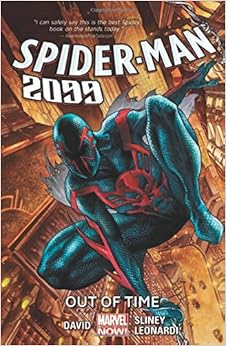
Spider-Man 2099 Vol. 1: Out of Time (Marvel NOW!) Review

Starring the time period that definitely
ISN'T on the cover.
Writer: Peter David

Artists: Rick Leonardi and William Sliney

Collects: Spider Man 2099 #1-5 and Amazing Spider-Man #1 (2099 excerpt).

Background Information:

The Spider-Man of 2099 is a creation of the 90s- one of the few to remain unhated since the era passed. The story goes that in 2099, Miguel O'Hara got his genes spliced with that of a spider, and became that era's Spidey.

With us so far?

Good, because in Dan Slott's Superior Spider-Man, Miguel was transported back to our time because some truly whacky things were happening with the space-time continuum. During that time, he became stranded there and found himself having to protect his great-grandfather, Tiberius Stone.

Review:

Not knowing where a series is going is often a good thing. Not knowing if the series really wants to go anywhere? Not so much.

That's the feeling I get when reading Out of Time; a book that shows plenty of potential for the series- but doesn't convince you that writer Peter David even cares about capitalising on it.

Is it just me, or would all the Spider-characters make awesome
ballerinas?
So Miguel is now working at Alchemax- a relatively young company now that will become an evil
monopoly by 2099- and hasn't he just achieved every millenial's dream?! He's entered the company on an executive level and done so just by showing up. After a futuristic cop tries to kill Miguel; forcing him to take him on as Spider-Man, Alechemax boss Liz Allen figures out that her out-of-the-blue worker and the Spidey with a skull on his chest are one and the same. She comes with a proposition: work for Alchemax as Spidey, or get outed as the same.

Have a guess which one Miguel choses.

To be fair; this is a good status-quo. Liz is clearly in control here, and Miguel has no choice but to follow suite. It leads him, for example, to follow Tiberius into what is either the Middle East or South America for the express purpose of selling Spider-Slayers. It also allows him to see the other super-types that Alchemax has under their employ. Here's a clue: they're bad people.

David has also written a great supporting cast here. He's been wise to keep the supporting cast relatively small. We're introduced to Tempest, a landlord who's been diagnosed with leukaemia and therefore doesn't let others get close to her. We're also re-introduced to Lyla- Miguel's wrist-mounted Siri-like hologram. It's her interjections and take-everything-literally mistakes that bring some of the more sunny moments to this book.

This could all work into a situation like what we have in DC's Grayson, where the title character is now working within the evil group to bring it down, but we don't get that here. David created the original Spidey 2099 character in the 90s, and presumably knows Miguel's relationship with Alchemax isn't great. It feels like a lost opportunity.

Spider-Slayers take tag seriously.
And I don't think David is likely to take advantage of this. The series is set to be re-numbered after volume 2 (which is based more around the Spider-Verse crossover) and bring Miguel back into the future. I don't think one volume is enough to really capitalise on the really intriguing status-quo that David has set-up. I know it's unfair to judge one volume on what comes next, but when you get invested in a series, you want a guarantee that your investment is going to result in a fully-realised story and it doesn't look like it will be.

The art is fine, but unmemorable. There's nothing particularly ugly here, but I couldn't tell this artwork from the myriad of other art styles out there. It thankfully doesn't get in the way of David's writing, though and even allows it to be as witty or engaging as you can. Here, you're reading a story more than looking at pictures.

It's a rare moment when I have a five-star love for a book but know that there are legitimate flaws. As much as I love Out of Time, I still have to give it a three out of five wrist-mounted Siris.

Tuesday, 29 September 2015

Hawkeye Vol. 3: L.A. Woman (Marvel NOW!) Review

Hawkeye Volume 3: L.A. Woman

Hawk-not-guy!
Writer: Matt Fraction

Artists: Annie Wu and Javier Pulido

Collects: Hawkeye #14, #16, #18, #20 and Annual #1

Background Information:

For the past two volumes, Clint Barton (AKA Hawkeye), has been defending his aparment complex from a gang of Russians dressed in tracksuits. At the end of the last volume, however, Clint decided he was going to "bail" as young Hawkeye, Kate Bishop, puts it. Kate didn't like that, so she up and left to L.A, taking the pizza dog Lucky with her.

Review:

You hear a lot of calls for female-led books in the comic industry. You hear a lot of calls for more light-hearted fun in comics. If there was ever a solid argument for both, though, it's L.A. Woman.

Hawk-not-guy on computers!
So upon entering L.A., Kate is promplty robbed and left broke. Only having her skills as an archer/superhero at hand, she sets herself up as a hero for hire. All the while, Madam Masque lurks in every mission she takes. I think what I love about this particular format of storytelling is that it tells a complete story like the previous volume, without sacrificing the done-in-one episodic format that made me love the first Hawkeye volume. Each mission feels like it's own thing, but somehow it links back to Madam Masque. It allows for a light-hearted comic where the stakes feel high. That's a difficult thing to accomplish, and massive kudos goes to Matt Fraction for pulling it off.

Kate's character has always been well-written by Fraction, but gving her a chance to shine in what could easily classify as her own solo book is golden. Kate's got a very different voice to Clint. She feels younger and more energetic. Fraction even gives Kate her own slang; with liberal use of the word "futzing" and he catchprase "Momma like" being the standouts.

It's actually amazing how "un-Clint" this book feels withot feeling like a seperate series altogether. The basic elements of the Hawkeye comic up til now are retained; a gang of bellboys suitably replaces the tracksuit draculas, a scruffy-looking man with a dark past fills the void left by the redhead in previous volumes better than she initially filled it, and the ground-level, almost trivial threats are basically retained. Unlike other series that have made major changes (here's looking at you, Batgirl), this change feels natural. It's masterful.

This is the first time I've had to talk about art using two paragraphs, but here goes. Most issues here
are drawn by Annie Wu and while I miss the rough pencils of David Aja, Wu  makes a decent, albeit not equal substitute. She captures Kate's body language brilliantly. With the costume that Kate wears for most of the book, it would also be tempting for writers to draw the character so that the holes in her costume were emphasised. Thankfully, that's not a temptation that Wu succombs to. The holes at her waist, rather than being the focus, seem to just be there to break up the solid purple that otherwise dominates her costume. That's appreciated, and it's something that I want to see more of in the next volume.

Hawk-not-guy in a comic... somewhere...
Javier Pulido's art is another matter. Puido draws the art in the Annual and for a large chunk of the book, it feels like the guy wasn't all that interested in actually drawing anything. Black silouettes take up places where characters shold be in many panels and while this would be clever and nice-looking in small doses, Pulido spams pages with it. Eventually you just want to shake the book and yell "FOR CRYING OUT LOUD! ACTUALLY DRAW SOMETHING, WILL YA?". He partially makes up for it, though, by putting Kate's facial expression in text boxes. That was a nice touch and something I was sad to see absent in other issues.

L.A. Woman is a near-perfect book. It gets a four and a half out of five silloute costume holes.

**** 1/2