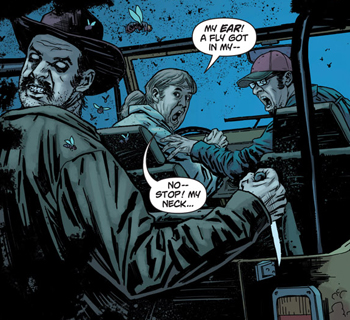
Swamp Thing Vol. 3: Rotworld: The Green Kingdom (The New 52)
"Okay, you go get 'em... you've got a
gun..."
Writers: Scott
Snyder and Jeff Lemire
Artist: Yanick
Paquette
Collects:Animal Man 12,17 and Swamp Thing12-18
Background
Information:
Number Four in Scott Snyder Week!
Swamp Thing is the avatar of The Green, which give life to
all plants. Animal Man is the avatar of The Red, which gives life to all
animals. The main villain in Rotworld
is Arcane; the avatar of The Rot which is the force behind death and decay.
That’s basically all you need to know for the set up- to
this book, but you should also know that this volume contains only half the Rotworld event. The other half is
contained in Animal Man Vol. 3: Rotworld:
The Red Kingdom. If you’ve just been reading the Swamp Thing stories, though, there isn’t a whole lot you need to
know from Animal Man.
Review:
Rotworld marks the
end of Scott Snyder’s run on Swamp Thing,
and it’s an immensely satisfying end. I’ve rated Snyders work pretty highly in
general, but this is a book I would prefer even over Snyder’s Batman. That’s right, DC, I would sooner
see more of a creature from the black lagoon than stinkin’ Batman Eternal. In fact, even though this Swampt Thing volume isn’t perfect, it’s damn-near close.
In this volume, Swamp Thing and Animal Man follow Arcane
into The Rot and become trapped in it. When they finally emerge, it’s one year
later, and the world has gone to hell. I say that almost literally, as now The
Rot has all but taken over the earth. It’s infected all humans who have no connection
to The Red or The Green, turning them into zombie-like rage creatures. It falls
on Swamp Thing and Animal Man to amass armies strong enough to take down
Arcane, and stop The Rot’s stranglehold on the world, all the while saving
people who are very dear to them.
In Swamp Things case, that person is Abigail Arcane, the
girl voted most likely to become zombie queen in high school (okay, there’s
some artistic licence there, but she is meant to be the next avatar of The
Rot). I won’t go give away the ending, but when Swamp Thing and Animal Man
finally meet their loved ones, it’s a crushing blow to both characters. I would
argue that the moment probably damages Animal Man more than it does Swamp
Thing, but the moment is still fraught with emotion.
If you’re writing for DC and you do a big, alternate-world
story, you have to reference some of DCs bigger names, and Lemire and Snyder do
a good job of that by presenting us with “rotified” versions of Batman,
Superman, Wonder Woman and other more celebrated DC heroes. This isn’t a new
idea- Geoff Johns did it a while ago in Blackest
Night, but here it makes more sense here. Here, heroes joining The Rot is
inevitable, so it’s natural that the Justice League would fall to it. Those characters
who don’t join the rot mostly make sense- Poison Ivy is naturally connected to
The Green and how could Beast Boy not be connected to The Red (like his new...
skin tone[?]... didn’t give it away already)? It’s cool to see these b-list
characters save the world.
The art here has been pretty consistent with the previous
two volumes. There’s not much difference to notice between the Swamp Thing and Animal Man issues except the page design of Animal Man seems a little too neat in comparison to Swamp Thing. But that’s a small qualm
when the art is just so damn enjoyable. The Rot are characteristically
disgusting and there are plenty of awesome moments to look at.
Rotworld: The Green
Kingdom finishes Snyder’s Swamp Thing
run brilliantly. It gets my first perfect score of five out of five
most-likely-to-become-zombie awards.
*****
+ Emotive story
+ Good use of A and B list characters
+ Art continues to be gorgeous
Alternate Option: Animal Man: Rotworld: The Red Kingdom
Eww... Don't touch them, Swamp Thing!
You have no idea where they've been!
Writer: Scott
Snyder
Artists: Yanick
Pquette and Marco Rudy
Collects:Swamp Thing #0, 8-11 and Swamp Thing Annual #1
Background
Information:
Number three in Scott Snyder Week!
Okay, so if you missed my review of volume 1, Swamp Thing is
the avatar and warrior king of the Green. He has control of plant life and is
able to make all kinds of things from it. He fights the Rot- a force of death
and decay. In essence, you’re looking at a cooler version of Plants Vs. Zombies.
In the last volume, Swamp Thing’s civilian identity, Alec
Holland developed a bio-regenative formula which helped plants to grow- that’s
a major factor in both this and the next volume of Swamp Thing, so don’t forget it.
Review:
When I read the first volume of Swamp Thing, I was half-expecting an eco-story that was going to
point out the dangers of global warming. I was pleasantly surprised when I
found a horror story that was going to live longer than whenever we find out
the next way that we’re destroying the planet. Instead, Family Tree is part of a three-volume epic that definitely has the
potential to outlive present-day concerns, and that’s the mark of a classic.
That said though, Family
Tree is still a relatively weak middle for such a strong run. Mostly because
the structure of this story is nowhere near as tight. Essentially, you’re
reading two stories; the first sees Swamp Thing, having finally made the
transformation from Alec Holland, setting out to rescue love interest Abigail
Arcane from becoming a servant of The Rot. It features some amazing action
sequences that feel brutal and terrifying. Up until now, we haven’t seen the
full extent of what Swamp Thing is capable of, and this volume shows that
brilliantly.
The second arc, though, is really a collection of flashbacks
that connect Swamp Thing to The Rot, and, more particularly its avatar Arcane. There
are some interesting origin stories told in these issues, but reading them at
this late stage in the story feels like a distraction, and not a fun one. While
reading you get the feeling that something much better is happening in the present
that Snyders not letting us see. Even the best writers can sometimes write
unsatisfying stories, and this is an example of this principle in practice.
What this volume does well, however, is set up the third
volume in this series rather well. By the end of Family Tree, we are genuinely scared of Arcane, even though his
motives seem to be little more than “because he’s evil”. Things are still
looking hopeless for Swamp Thing, and here, it’s a very good thing, since the
next volume is an amazing crossover with Animal
Man.
The art here is just as good as the previous volume. Thick,
ungraceful lines and chaotic panelling work fantastic here. There are some more
guttered pages in the collection’s 0 issue, but it’s easily forgivable
considering that this issue references an era when Swamp Thing was still Doctor
Alec Holland. It’s a stage where his life was calmer, more organised and the
page layouts show it well.
In both Family Tree
and the last volume, Raise Them Bones,
Snyder has treated his artists to some truly spectacular locations to draw-
ones to match the bizarre creatures contained in the book. High foreign
mountains, hellish pits and wild jungles abound in Swamp Thing, and the team of Paquette and Rudy do an excellent job
of making these environments so easy to immerse yourself in.
Family Tree is an essential read if you are intending on reading
anything in the upcoming Rotworld
crossover, but it’s hardly the most exciting of the series. It get three and a
half out of five Plants vs. Zombies.
*** 1/2
+ Great first half that shows off Swamp Thing’s abilities
+ Amazing location art
- Second half of the book feels like it doesn’t need to be
there.
Alternate Option: Animal Man: The Hunt
The Animal Man series
directly ties into Swamp Thing, so
reading this one is well worth it.
I’ll admit, for too long I had dismissed Swamp Thing as a book that was “too
weird” for my tastes.And yeah, it’s
pretty weird- Swamp Thing is listed
under the “horror” subsection of DC’s New 52, along with Animal Man and Justice League
Dark. But don’t dismiss it- Swamp Thing is every bit the superhero that
Superman or Batman are.
Alec Holland was a brilliant biochemist until a lab
experiment killed him. Post-death, Holland was found by an entity known as the
Parliament of Trees and chosen to become the Swamp Thing. Swamp Thing is the
avatar of the Green- the life force that controls plants. As such, Swamp Thing
can also control all plant life- creating anything out of vines, like his
wings, or a large, tough-looking blade.
Review:
If there is a book that makesa good argument for not having more Batman titles, it’s Swamp Thing. It’s kinda ironic, considering that the series is
written by Batman writer Scott
Snyder, but it goes to show that a great comic is more about who’s writing it
than which character’s name is in the title.
So in this title, Alec Holland has been Swamp Thing before
and well and truly believes that he’s finished. Not so, a life-force known as
The Rot is resurfacing with a young boy as its avatar. The Rot is the force of
death and decay, and it’s starting to build its own kingdom on earth. In
response, the Parliament of Trees calls on Swamp Thing to defeat it.
But Alec is done being Swamp Thing. He has too many
haunting, disjointed memories of the experience and never wants to take on the
mantle again. There’s a great message about personal sacrifice here. We want to
sympathise with Alec- being Swamp Thing is a living hell and nobody would
actually want to be him. At the same time though, there is a zero per cent chance
that the human race will survive if Alec doesn’t take on the Swamp Thing
mantle, so we also end up seeing him as somewhat selfish for his reluctance. It
makes for a deep, multi-layered character that none of the Justice League has
really managed to pull off just yet.
Equally interesting is Alec’s love interest Abigail Arcane, a
woman with a deep connection to The Rot. Snyder somehow manages to balance
Abigail’s part as both a love interest to be rescued and as a strong female
character who is more than capable of handling things herself. It’s fascinating
to see this line walked so well and by the end, you are cheering for both
Abigail and Swamp Thing equally.
There’s some brilliantly dark dialogue in Raise Them Bones. Snyder gets the horror
comic genre perfectly, allowing the dialogue to be highly entertaining without
it being funny in the least. There’s a weird belief around comics at the moment
that in order to be entertaining, a book has to have humour. DC’s been
regularly attacked for not having enough humour in their books. While there are
some titles about which I could say that’s a fair comment; Swamp Thing isn’t one of them. It’s appeal comes from visiting that
dark side and being completely removed from your comfort zone while going
somewhere rather disturbing.
And at the end of the day, it’s the art that really drives
that disturbance home. Undead humans with twisted necks, zombie pigs with
soulless eyes and other twisted creatures made of rotting flesh abound in this
collection and they look as unnerving as they sound- possibly more. Okay, sure,
some of the creatures of both The Green and The Rot look like rejected pokemon,
butthey’re scary rejected pokemon. The book also benefits from the total lack
of gutters in the page design. Panels are separated at odd angles with
blood-splatter and vine shapes and give the book a chaotic feel that suits a
horror story like little else can.
My one gripe with Raise
Them Bones is that for a book in a series entitled Swamp Thing, you see a lot more of Alec Holland. Swamp thing only
appears at the end of the book which is a problem when that’s the title of the
book. If the book was called Scary
Rejected Pokemon, I’d probably be okay with it, but I imagine you buy a comic
called Swamp Thing, you want to see
Swamp Thing.
But all the same, Raise
Them Bones is an excellent look at the horror genre and it gets a four out
of five scary rejected pokemon.
****
+ Well-developed characters
+ Dialogue that is great despite a lack of humour
+ Art is gorgeously creepy
- Swamp Thing doesn’t actually show up that much
Alternate Option: Batman: The Court of Owls
Another great one by Snyder, and if you’re worried about a
book about a swamp monster being good, you can at least check out Snyder’s
talent here.
Two men- one writer. The winner? Whoever the writer wants it to be.
Ever since Man of
Steel 2: Superman Vs. Batman was announced, the internet has been burning
with arguments about which of DC’s heavyweights would win in the upcoming bout.
Fans have compared stats, argued about moments in comics, and pitted virtues
against vices to try to figure out who would realistically beat who.
There’s an inherent problem with this thinking; it suggests
that this fight will be taking place in the real world- one not controlled by
the will of screenwriters and directors. There are plenty of reasons that
either Batman or Superman will come out on top here, but it’s got nothing to do
with skills or powers or even who the cooler character is. The winner will
ultimately be whoever the writers think should win. With that in mind, I’ve put
together a list of top 5 reasons why each character would win from an artistic
perspective.
Let’s start with Batman, shall we?
"Finish this sentence: BECAUSE I'M..."
5. The Dark Knight Returns
When Man of Steel 2
was announced, lines from Frank Miller’s The
Dark Knight Returns were read. The
Dark Knight Returns a Batman story in which, yes, Batman beats Superman in
a massive techno-suit. You’ll recognise some moments from it in Nolan’s The Dark Knight Rises. In recent
interviews MOS2’s creative team have
mentioned that The Dark Knight Returns
is one of the texts that they are working off. It makes sense to use that
story, as it’s probably the most popular Batman/Superman fight out there, and
it does more than just hint at a probable Bat-victory.
4. It’s expected
Even without the press releases surrounding The Dark Knight Returns, there’s still
an expectation that Batman will win the fight. He’s become well-known as a
strategist. I said that I wouldn’t focus on character traits for this, but
people seem to be expecting a Batman win here- even if they haven’t read The Dark Knight Returns.
3. It’s a more
interesting victory
Superman punches Batman, and Batman loses a head- that’s not
an interesting fight. Batman watches Superman from the shadows, puts together a
kryptonite ring and systematically lures Superman into a fight- that’s an interesting fight. Brain vs
Brawn (and before anyone complains, I know Superman has brains too) is always
an interesting contest- especially when brain wins. It allows writers to be
clever with how they write their fight scenes, and writers so very much like
being clever. With that in mind, yes, a Batman victory would be very likely.
2. Batman’s character
is appeals to a wider audience
Batman has a HUGE fanbase compared to Superman these days.
It’s sad, but Superman doesn’t get the same following: he’s perceived as being
overpowered, too goody-goody, and just not as tough as Batman despite being
able to punch people through buildings. Batman, on the other hand, is about
embracing inner darkness that we all find so appealing. His character speaks to
our inner desires to let the darkness out once and a while. It speaks to that
teenage boy dream most of us have had at one stage or another to instil fear in
those that we see as a threat. Superman, on the other hand, instils boring old
hope. With that kind of fanbase, the rage that could result from Superman
winning this fight could be terrifying.
1. It would put
Affleck’s Batman in a good light
The complaints worldwide about Ben Affleck as Batman haven’t
exactly helped Affleck’s case, here. He needs to do something pretty cool if
he’s going to win over the hearts of Batman fans; many of whom became converted
through Nolan’s Dark Knight trilogy.
So what’s something cool that Affleck’s Batman could do? How about beat up the
most powerful man in the DC universe?
Yeah, that would do it.
Affleck needs to be put in a good light, and being the
Batman who beat Superman could be just the ticket for him.
So that’s the reasons Batman would win, but it wouldn’t be
right if we left it at that, though. So here are the reasons Superman would win
from an artistic perspective.
"I'm not finishing your damn sentence!"
5. Canon
Yes, everyone knows that Batman beats Superman in The Dark Knight Returns. What tends to
get ignored, however, is the fact that Frank Miller’s story is an “alternate
universe” tale that has nothing to do with DC’s main comic storyline. If you
look at DC’s mainstream storyline, Superman has beaten Batman multiple times.
If writers are looking for material, they could find a lot more to use that
works in Superman’s favour. The creators of MOS2
have mentioned that they are not directly adapting The Dark Knight Returns, so it would make sense to look at some of
these other stories, too.
4. No Kryptonite yet.
The big arguments for Batman beating Superman is that Batman
is a planner. Part of that argument involves the fact that Batman keeps
kryptonite in the Bat-Cave just in case Supes goes rogue. The problem with
putting that angle in MOS2, however,
is that kryptonite has yet to be introduced to DC’s new cinematic universe.
That’s not to say it couldn’t happen, but we have to assume that, for the
moment, kryptonite doesn’t exist. Without Superman’s most popular weakness
handy, it would be hard to write a believable way to defeat the Man of Steel.
3. Superman is
actually more relatable
You can talk all you want about how Batman is relatable
because he has no powers. But at the end of the day, Batman is a one-percenter.
Born into a life of luxury, having all the money he could possibly want, it
gets hard to sympathise with Batman unless you’ve gone through his life story.
Superman, on the other hand, may have powers up the wazoo,
but, at heart, he’s the 99%. He’s a blue collar man raised by simple farming
folk with a middle-class job as a human-interest reporter. Compare that to the
rich boy, who is rumoured to start MOS2
being buddies with Luthor, and it’s pretty clear who writers are more likely to
sympathise with.
2. Superman is DC’s
front man
If Batman, Wonder Woman and Superman are DC’s holy trinity,
Superman is their God. As much as Batman fans like to pretend otherwise, Superman
is really at the centre of DC’s universe. Look at as many pictures of the
Justice League as you want; I guarantee you, Superman will be at the centre.
He’s the one taking on DC’s most powerful villains, he’s the one pulling of
DC’s greatest feats. In the edited words of Morgan Freeman “And you’re thinking
of taking on this man? Good Luck!”
1. This is Superman’s
movie.
If there’s one argument that artistically justifies Superman
winning this fight, it’s this one. This is the sequel to Man of Steel. So far as we are aware, this is a movie about
Superman, not Batman. Supes is the star, not the Dark Knight, despite all the
attention being given to Ben Affleck. Do you really think they’ll make the
titular character lose? Sure, it’s happened before, but it’s highly unlikely.
In all honesty, though, there are plenty of reasons a writer
could make either character lose. What do you think? Are there other artistic
reasons I missed? Leave a comment below.
Batman's football team is going all the
way this year.
Writers: Scott
Snyder and James Tynion IV
Artists: Greg
Capullo, Jonathon Glapion, Rafael Albuquerque and Jason Fabok (Phew!)
Collects: Batman #8-12 and Batman Annual #1
Background
Information:
Welcome to Scott Snyder Week! 5 books by Snyder over five days!
If you haven’t read Scott Snyder’s spectacular Batman Vol. 1: Court of Owls, then this
is book might go over your head. What’s worse, though, you’d be missing half of
one of the greatest Batman stories of all time!
But, if you’re stubborn, the Court of Owls are a group of
wealthy Gothamites who secretly rule Gotham from the shadows. They also have a
penchant for sending assassins named Talons to kill people they don’t like. In
the last Batman volume, the court
uses a special regenerating formula to bring back the Talons from the last two
hundred years with Wolverine-like healing powers (theory: the dude’s in so many
books that he’s spilling over into DC) to boot and sending them out to “take
Gotham city”.
Review:
For a book called The City
of Owls, this collection spends a lot of time either in Wayne Manor, or in
Gotham after the court has been defeated. When Gotham is a city of owls, we’re
not in the city and when Batman is in the city, the Owls have pretty much
vacated. But that’s okay, because The City
of Owls is a brilliant end to one of the best Bat-Stories you’re likely to
read in years.
So after Batman’s escape from the court, Bruce is left
emotionally broken. The Gotham that he once thought was his city doesn’t exist
and in its place is a dark entity in which Bruce is just a guest. It’s
precisely at that moment that an army of Talons comes to Wayne manner with the
intent on murdering the billionaire playboy. It seems like overkill, but Bruce
was able to avoid a Talon before (and not as Batman), so I guess the Court
really wants him dead.
The Court of Owls established themselves as great villains
in the last book, and here is no different. The whole concept of the Court is
unnerving. It’s great to see that Snyder understands that the best Batman
stories are only 50% action at most- usually only about 30%. The rest is
usually equal parts mystery and horror. The
City of Owls pulls this off by giving us villains with emotional complexity
and a serious mental problem.
Central to the last volume was the theme of control. That
theme doesn’t play out as strongly here, instead, themes of privilege and
secrecy are central to this one. I won’t give too much away, as it’s pretty
essential to how this story plays out, but it ties the Wayne family directly to
the Court of Owls.
While there are some pretty dark moments in this collection,
they somehow don’t hit the mark the same way that they did in Court of Owls, instead, we’re mostly
getting an action story. It’s a pity to see the element of psychological horror
that made the previous volume so awesome left out, but the action here is more
than satisfying enough.
Admittedly, some of the book tends to drag on a bit, and
none so more than the Batman annual
that revamps Mr. Freeze’s origin for the New 52. I love Mr. Freeze. When I was
a kid, the best news I got was that Mr. Freeze would be appearing in Batman And Robin back in ’97 (don’t
judge me). But by the time I got halfway through the annual, I was ready for it
to be over. They aren’t moments that make the book awful, but they break the
momentum of an otherwise perfect book.
One of the things I’ve been complaining about with the New
52 is the artwork. It’s generally very good, but there seems to be too much
that looks the same. Ivan Reis, Doug Mahnke and Jim Lee are all excellent
artists, but their art tends to look the same. That’s not something I can say
for Batman’s main artist Greg Capullo.
The dude has been drawing Spawn for
years, and some of that creepiness and gritty lines has rubbed off on Batman.
Thanfully, it suits the Dark Knight like a glove and, more importantly, it’s a
book that I can say looks like Batman and not like Justice League or Green
Lantern.
Overall, this is a series that if you’re not reading, you
should be. I now can’t imagine anyone other than Scott Snyder writing Batman (and for the record, I have read
work by Grant Morrison and Tony S. Daniel). The
City of Owls gets a four and a half out of five Wolverine appearances.
**** ½
+ A seriously well-developed villain
+ Art is distinctive and looks fantastic
+ Works well thematically
- Some parts of the book drag out a bit
Alternate Option: Nightwing: Night of Owls
This book ties directly into City of Owls, so it’s definitely worth a look.
BOOM! studios has made some excellent superhero books over
the past few years, Mark Waid’s Irredeemable,
for example, was highly praised.
You can imagine the hoopla when comics legend Stan Lee (Y’know,
the creator of Thor, Spider-Man and a
swathe of Marvel heroes) designed three new superheroes for the publisher! I
can only imagine that it would have been the comic industry’s version of new
toys at Christmas.
Review:
So Benjamin Warner is an aspiring sci-fi writer who is more
than a little down on his luck. Imagine his surprise when the characters he thought
he made up start coming for him in real life!
See, Benjamin is apparently from a distant planet where
everything he thought he made up is real and coming to kill him.
Oh, he’s also prince of said planet.
There’s a fine line to writing fun superhero books- make it
too dark and it becomes depressing; make it too funny and it’s hard to take
seriously. Beyond the Stars somehow
walks that tightrope very well, making a story that is equal parts dark and humorous.
Each moment where Benjamin discovers a new one of his characters out to get him
is a great illustration of this. One moment scary-looking creatures are
attacking, the next, Benjamin is freaking out about how what he thought was
fictitious is suddenly attacking him in the goofiest manner possible.
Benjamin himself is a surprisingly relatable character. He
has aspirations early on that get, well, crushed, and his response to it is
incredibly human- he comes to resent his job and is even a little embarrassed
about his novel in the first place. The result is this that Benjamin feels
instantly tangible. Is he a particularly deep character? Not at the moment, but
he’s plenty of fun- something that has really been missing from the big two
publishers lately.
The best thing about Beyond
the Stars, though, is how accessible it is to kids. I don’t usually rate
comics on kid-friendliness, but this one seems to have nailed it. The violence
isn’t extreme, no sexual innuendo or truly scary situations- it’s a good, clean
book. Thankfully, the characterisation and situation that Benjamin finds him in
means that this book is equally accessible to adults. That’s a hard thing to
pull off. I get disappointed when Marvel and DC very clearly have marked out
books that are the “real” versions of their superheroes and “the kids version”.
I don’t think is helps bring kids into comics when they know they are just
getting the substitute. Beyond the Stars,
though, gives kids the real hero, and any comic-reading parent will tell you
that that’s something pretty special.
It’s not all smooth sailing for this collection, though,
four issues makes the story feel a little half-baked, especially when the book
leaves you with a non-ending. What’s more the story itself is pretty shallow;
consisting mostly of “meet group of bad guys and run away) scenarios. They’re
exciting situations, to be sure, but don’t make the mistake of thinking that
there is a deep story happening here.
The art in this volume, though, is just as fun as everything
else in the book- cartoony colours and lines look
great and bold colours
throughout are distinctive and varied. It’s the kind of art that instantly
looks both atmospheric and silly- somehow striking a perfect balance between
the two.
Beyond the Stars
is a good introduction to BOOM!’s character. It gets a three and a half out of
five excelsiors.
*** ½
+ Strikes a balance between humour and darkness
+ Benjamin is a great character
+ Art is both silly and atmospheric
-Not enough in the story
Alternate Option: Soldier Zero: One Small Step for Man
Another one of BOOM!’s “Stan Lee Specials”, worth a look.
Okay guys, let's all look ignore the fact that
Iceman's not wearing any pants...
Writer: Brian
Michael Bendis
Artist: Stuart
Immonen
Collects: All-New X-Men #1-5
Background
Information:
Ever since around 2000, the X-Men leader Cyclops has been
getting more and more nasty. When the world mutant population got cut down to
around 200, Cyclops became more militant, sending the X-Force to covertly kill
anti-mutant lobbyists and relocating to Magneto’s old home on Utopia. It lead
to the permanent splitting of the X-Men between Cyclops and Wolverine. When the
phoenix plot device... sorry, I mean phoenix force... came back to earth,
Cyclops was officially pushed over the edge and killed his mentor, Charles
Xavier.
But the dude’s named after a mythical Greek monster famous
for killing people; shouldn’t be a surprise, right?
Review:
So now that Cyclops is completely gaga, the rest of the
X-Men are left in a state of shock. Cyclops has been leader of the X-Men since
day one and nobody is less impressed by Cyclops’ change of character than Hank
McCoy, also known as Beast. Like Cyclops, Beast was one of the original X-Men
and he knows that years ago, Cyclops would have hated what he has now turned
into. But things are still pretty bad for the big blue X-Man. He’s continuing
to mutate and it’s starting to kill him. In a last desperate attempt to make
things right before he dies, Beast travels back in time and brings the original
X-Men from yesteryear into the present. For those expecting a young Wolverine,
this means younger versions of Cyclops, Jean Grey (not just a younger version,
but an alive version to boot), Beast, Iceman and Angel. In X-Men history,
Gambit, Rogue, Wolverine and Storm all joined the team much later.
Beast’s intent is to remind Cyclops of his past self and
thereby encourage him to stop killing people. What it actually ends up doing is
freaking out pretty much everyone in the X-Men franchise. Time travel is a
logical nightmare when telling stories. Thankfully, writer Brian Michael Bendis
uses some of these problems to not just further the narrative, but develop the
characters he writes. It’s a relief and it actually allows Bendis to do what he
really does best.
The X-Men that Beast brings back are all teenagers- aged
between 12 and 18. Bendis is best known for writing Ultimate Spider-Man back in the early 2000s and there he absolutely
nailed the teenage voice. In Yesterday’s X-Men, Bendis is back in his
element. There is a distinct difference between the way young and old Cyclops
talk, between young and old Iceman (though to be fair, they are both absolute
goofs) and even Jean Grey actually sounds
like a teenager. The only character for whom Bendis misses the mark is Beast;
who, despite being twelve, talks like a twenty-year old. I understand that even
the young Hank McCoy is a genius, but there is a difference between smart and
mature that I don’t think Bendis realises here.
But ultimately this book is a thematic triumph. The book
deals with the very relatable conflict between innocent idealism and worldly
jadedness. The great part here though, is that innocence isn’t a weakness. For
the young X-Men, their innocence is what drives their idealism. They have yet
to “learn” that peace between humans and mutants can’t happen and as such, they
get great power from believing that it is possible. In a world where too many
people mistake innocence for weakness or even stupidy, it’s nice to see the
innocent triumph.
The art is done entirely by Stuart Immomen, who just does an
amazing job at character designs. The young X-Men are all wearing the original
yellow and black costumes. Their civilian clothes include ties for the boys.
Jean Grey sports a haircut that went out of style in the sixties. It would have
been so easy to “modernise” these characters to make them dress and appear “cooler”,
but Immonen takes a harder, yet more impressive route. Somehow, he makes these
old designs appear fresh through excellent use of light and shadow and
brilliant use of movement and expression.
My only real issue from the book, apart from young Beast “all-too-old”
voice, is the newer mutants that are introduce in this volume. Because Bendis
spends so much time developing the new status quo around the already well-known
characters that the newer mutants introduced in this book seem more like
afterthoughts. I’m supposing, that since they are on old Cyclops’ team, that
they will appear in Uncanny X-Men (also
written by Bendis), but at the moment, I’m just left to wonder why they’re
there.
Yesterday’s X-Men
is an awesome hearkening back to the days when X-Men was more simple. It’s an emotionally charged book that gets a
four out of five Greek monsters.
****
+ Character designs
are excellent
+ Themes are poignant and relevant
+ Bendis almost perfectly writes the teenage voice
- Young Beast sounds a little too old
- Are we supposed to care about the new mutants?
Alternate Option: Uncanny X-Men: Revolution
Admittedly, it’s not one I’ve read yet, but it’s the companion
book to All-New X-Men, so definitely
worth a look.