I've been wanting to do a series of articles like this for a while.
The point of this is to take a word that gets thrown around geek culture communities- one that's often weaponized for some reason or another and show just how... nothing... that word really is. There's a lot of negative speak in geek communities and really, a lot of it is just that: speak for speaking's sake.
Why now? Well, it seems like an ample time to start. Recently, the Spider-Man rights went back to Sony, angering MCU fans, and getting Sony fans on the defense. We also had rumors going around that Bruce Wayne was going to lose the mantle of Batman to have it taken up by an unspecified black guy. People on the internet are STILL arguing about Batman v Superman three whole years after it's release in theaters. And don't get me started on whatever happens whenever someone mentions The Last Jedi. In all of these... *ehem* highly intelligent debates... the word "fanboy" has been passed around like the last cigarette in a mass execution.
So yeah, now seems like a good time to talk about the word "fanboy" all the things it gets used for and why it probably make you look stupider than the person you're using it on. For the record, anything here could be equally applied to the way fandoms use the word "apologist"- "fanboy's" upstate cousin.
Let's start with it's general usage, shall we? The word "fanboy" is typically taken to means someone who will only say good things about a thing regardless of the thing's imagined "objective" quality or lack thereof. I put "objective" in quotation marks because... well, it's honestly my plan for the next Scary Words article, but the short version is that what does and doesn't count as objective in art is far from cut-and-dry.
But it brings up the first problem with the fanboy argument. It is dependent entirely on the views held by the one using it. The person using it automatically assumes that his (for it is so often a "he") viewpoint is universal- that every person hates BvS or The Last Jedi or Spider-Man: Homecoming. and that this universality makes his opinion right. Though by recognizing that another person sees it differently in the first place, he proves his concept of universality immediately false. Absolute truths are true for every single person no matter what happens and irrespective of opinion- it's the reason nobody ever gets called a "gravity fanboy". If someone enjoys one thing that another doesn't, which one is the absolute truth? Opinions, even widely held ones are still opinions, so what is the fanboy argument really saying? That your subjective take on a thing is different to my subjective take on a thing and therefore... really, what are we concluding here other than that?
The next problem has to do with evidence. Because the evidence for accused fanboyism is almost always the same (that is; "I don't like a thing and you do therefore fanboy"), the burden of proof in an argument about who the fanboy is often a matter of who gets called it first. The accused then finds himself having to prove his logic, shifting the burden of proof onto the defense instead of the prosecution. The defense, after all, can't use such a weak argument a "Nuh-uh; you are!" and instead has to take the brand just because he didn't get to the keyboard fast enough.
By now it should be pretty clear that the term is often just a shopping mall of logical fallacies. In one convenient location, you have ad hominem, burden of proof, appeal to popularity and circular logic. You also have the no true Scotsman fallacy. Fanboys are often perceived as different to genuine fans. "Genuine fans", according to internet logic, would hate the thing that you like. No real fan would ever like The Last Jedi, so liking it makes you a fanboy. It is, by its nature, a weird and ironic form of gatekeeping; weird because the people it keeps out can't often be clearly defined, and ironic, as most fandoms in their early years were made up entirely of people who were those who liked things that were considered unlikable by any "normal" person.
Ultimately, though, the word fanboy is meaningless. It's attempting to associate capacity for logic with whether your personal taste matches popular opinion. If your under 25, it might be hard to imagine a time when geek culture wasn't mainstream. Today, nearly everyone male between 7 and 40 plays video games. Movies and TV based on comics are Hollywood's bread and butter. Dr. Who is popular in the US! But those of us getting to ages we never thought we'd see can remember a different time. Back then, we didn't NEED these things to be popular for us to enjoy them. Everyone else hated it? So what? We knew what it was and we knew it was good. At least, it was good for us. We were all "fanboys" back then, so why do we need to be scared of being so today?
That's all I'm going to leave you with for now. Next time, let's talk about the word "objective"- is it really as simple as Youtubers like to pretend it is?
Saturday, 7 September 2019
Thursday, 30 May 2019
The Pitch: Blue Fury and the Temple of Balance (Riskmen Universe)
You all thought I forgot, didn't you!?
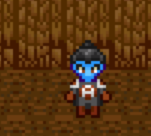
Today we give you the first female character of the Riskmen Universe and the first POC character. I give you Blue Fury and the Temple of Balance.
Before I start explaining this game, I want to talk a little about diversifying the Riskmen. I always wanted to make a more diverse team. Yeah, I know the first two characters I introduced were white guys, but that's it for the moment. That said, just about every character I made, I first had envisioned as white dudes. When I started to think more carefully about diversifying the line, I often asked myself "would this change make the character/story better, or am I just changing the race/gender for the sake of it?"
That said, for three out of the five initially conceived Riskmen, the answer to the question was "Yes, changing the characters in that way will actually make things better. I can explore new avenues in the character if I make these changes.
That said, let's get straight into it.
Influences
Storywise, a LOT went into figuring Blue Fury and her game. There's a little bit of Green Arrow, a little bit of Hulk, a little bit of Indiana Jones and a little bit of Hindu legend. There's elements of Star Wars, and a bit of Chinese Philosophy.
In terms of Gameplay, I'm using a LOT of Metroidvania for inspiration. Like all of my games, the SNES Zelda games are a big influence for me. The Secret of Mana and the Wolverine Origins have also given me plenty of ideas.
Story
Years ago, an emerging religious sect known as the Henkashi traveled southwest Asia preaching balance in all things. They had vanished from history for years until an old Henkashi temple was discovered on an island off the coast of India.
Enter Ashna Harolds, Indian Austrlian professor, and the archaeological team from Newchurch University. Keen scholars in Henkashi history, Ashna and her team are studying the ruins when the terrorist group Al Doraq attacks, seeking to exploit the power of the temple. Trying desperately to escape, Ashna finds herself in the centre of the temple, where a mystical bow bestows on Ashna the spirit of the Blue Fury. Now, to restore balance and save her team, Ashna must team up with the Blue Fury to defeat Al Doraq and rescue her colleagues.
Gameplay
Blue Fury's game is essentially what would happen if you took the 2D Zeldas and applied Super Metroid's structure to it. The entire game takes place in one temple. Well, I say one. The whole place is built on the concept of duality and balance. As such, the temple is made up of two structures, each one requiring tasks done in the other to progress. The temple is full of traps, creatures and puzzles designed to test Ashna and the Blue Fury to her limits.
As the Blue Fury, Ashna can fire off enchanted arrows quickly with deadly accuracy. As Ashna, she needs some time to draw the string and her arrows are unenchanted and less effective. She can, however look for clues, solve puzzles and climb up vines.
While playing as Ashna, Blue Fury can recover from damage. However, if the Fury runs out of health, Ashna will be on her own until the fury fully recovers.
The game works mostly on "shooter" mechanics, but is more like what would happen if Link only had the bow in Zelda games.
So that's it for Blue Fury. Let me know what you think. Next pitch will come sooner.
Before I start explaining this game, I want to talk a little about diversifying the Riskmen. I always wanted to make a more diverse team. Yeah, I know the first two characters I introduced were white guys, but that's it for the moment. That said, just about every character I made, I first had envisioned as white dudes. When I started to think more carefully about diversifying the line, I often asked myself "would this change make the character/story better, or am I just changing the race/gender for the sake of it?"
That said, let's get straight into it.
Influences
Storywise, a LOT went into figuring Blue Fury and her game. There's a little bit of Green Arrow, a little bit of Hulk, a little bit of Indiana Jones and a little bit of Hindu legend. There's elements of Star Wars, and a bit of Chinese Philosophy.
In terms of Gameplay, I'm using a LOT of Metroidvania for inspiration. Like all of my games, the SNES Zelda games are a big influence for me. The Secret of Mana and the Wolverine Origins have also given me plenty of ideas.
Years ago, an emerging religious sect known as the Henkashi traveled southwest Asia preaching balance in all things. They had vanished from history for years until an old Henkashi temple was discovered on an island off the coast of India.
Enter Ashna Harolds, Indian Austrlian professor, and the archaeological team from Newchurch University. Keen scholars in Henkashi history, Ashna and her team are studying the ruins when the terrorist group Al Doraq attacks, seeking to exploit the power of the temple. Trying desperately to escape, Ashna finds herself in the centre of the temple, where a mystical bow bestows on Ashna the spirit of the Blue Fury. Now, to restore balance and save her team, Ashna must team up with the Blue Fury to defeat Al Doraq and rescue her colleagues.
Gameplay
As the Blue Fury, Ashna can fire off enchanted arrows quickly with deadly accuracy. As Ashna, she needs some time to draw the string and her arrows are unenchanted and less effective. She can, however look for clues, solve puzzles and climb up vines.
The game works mostly on "shooter" mechanics, but is more like what would happen if Link only had the bow in Zelda games.
So that's it for Blue Fury. Let me know what you think. Next pitch will come sooner.
Saturday, 2 February 2019
New Rules: An Open Letter to Bill Maher
Dear Bill,
I saw your recent editorial on what you think about comic book fans, where you lambasted comic book fans for liking things that are "for kids". Now, I could go on and on in multiple paragraphs about why your wrong in the most academic manner I could manage. But in this case, I'll say in a way you understand.
New Rule: If you're going to comment on Kevin Smith's appearance, make sure you don't style your hair so that you look like you're caught in a wind tunnel. If you're wondering what a wind tunnel is, it's what happens when you and your audience stand ear to ear.
New Rule: If disagreeing with a statement proves it is true, then you have to admit you have proven the following; that the Bible is true, that the politically correct crowd is right, that Republicans are supremely intelligent and that comic book fans are the peak of maturity.
New Rule: If you've found comic books in supermarkets next to Pokemon cards, please tell me where shop. My kids are nuts about Pokemon cards and I like comics- it's a win-win. More to the point, comics haven't been sold in supermarkets since the mid-90s. This store you've seen them in? It's like Atlantis or an episode of Real Talk where you make a new joke.
New Rule: You need to look up the history of theater and novels before saying that nobody looked down on writers from either medium. Shakespeare wrote what people at the time considered populist trash. The theater was a place you went because you thought watching someone harass a bear was too fancy for your tastes. Novels were thought to be fanciful wastes of time when the truly mature were busy reading poetry. It's not a stretch to think that that there was a time when cavemen were complaining that "UG WASTE TIME ON CAVE PAINTING! SHOULD LISTEN TO ORAL TRADITION WITH NO PICTURES LIKE ADULT!"
And finally, New Rule: If you judge people's intelligence or maturity based on their hobbies, stop. Comic readers are teachers, professors, scientists and lawyers. They're not the uneducated buffoons you imagine them to be. They read widely- yes, even "real literature"; Shakespeare, Austin, Orwell. They raise families. They contribute to their community. And you want to rate them as childish because they read stuff you don't like?
There's a bigger problem here. I'm a teacher of high school English. Getting young people to read anything is a chore. I'd earn twice my paycheck if I had a dollar for every "I'm reading facebook posts, sir. That counts!" You know what appeals to these kids? Trash books. Comics, YA, stupid stories about the day their bum went psycho. I'll let you in on a little secret, Bill: you tell these kids not to read their favourite trash and their response isn't "Oh, well. Hemmingway it is, then." It's "If I can't read what I like, then I won't read." Reading comics is still reading. ANY reading builds literacy if it takes longer than three seconds. Don't blame a newborn for not being ready to walk out of the womb and don't be mad when non-readers pick up a comic instead of War and Peace- if you do, they'll likely never reach that point.
I started reading comics at age 25. It was an age when I realised that I was already mature enough. I realised it because I realised that maturity was about personal responsibility and I was raising a daughter and working to support her and my wife. It was about owning my mistakes and working to do better. It was about treating serious moments with the seriousness they deserve, and I found myself dealing with students who had been abuse victims in serious need of support in their schooling. And when I realised these things I realised something else: I don't need to PROVE my maturity to anyone. I know I'm mature and and people who want to say otherwise based on what I do with my downtime can find a very large cliff, look for the part with the most jagged rocks, strip naked and jump head-first. Adults do not need to pass your inspection, Bill. And I'm not going to take seriously the opinion of anyone who makes masturbation jokes on national television when it comes to which one of us needs to grow up.
sincerely,
Tom
I saw your recent editorial on what you think about comic book fans, where you lambasted comic book fans for liking things that are "for kids". Now, I could go on and on in multiple paragraphs about why your wrong in the most academic manner I could manage. But in this case, I'll say in a way you understand.
New Rule: If you're going to comment on Kevin Smith's appearance, make sure you don't style your hair so that you look like you're caught in a wind tunnel. If you're wondering what a wind tunnel is, it's what happens when you and your audience stand ear to ear.
New Rule: If disagreeing with a statement proves it is true, then you have to admit you have proven the following; that the Bible is true, that the politically correct crowd is right, that Republicans are supremely intelligent and that comic book fans are the peak of maturity.
New Rule: If you've found comic books in supermarkets next to Pokemon cards, please tell me where shop. My kids are nuts about Pokemon cards and I like comics- it's a win-win. More to the point, comics haven't been sold in supermarkets since the mid-90s. This store you've seen them in? It's like Atlantis or an episode of Real Talk where you make a new joke.
New Rule: You need to look up the history of theater and novels before saying that nobody looked down on writers from either medium. Shakespeare wrote what people at the time considered populist trash. The theater was a place you went because you thought watching someone harass a bear was too fancy for your tastes. Novels were thought to be fanciful wastes of time when the truly mature were busy reading poetry. It's not a stretch to think that that there was a time when cavemen were complaining that "UG WASTE TIME ON CAVE PAINTING! SHOULD LISTEN TO ORAL TRADITION WITH NO PICTURES LIKE ADULT!"
And finally, New Rule: If you judge people's intelligence or maturity based on their hobbies, stop. Comic readers are teachers, professors, scientists and lawyers. They're not the uneducated buffoons you imagine them to be. They read widely- yes, even "real literature"; Shakespeare, Austin, Orwell. They raise families. They contribute to their community. And you want to rate them as childish because they read stuff you don't like?
There's a bigger problem here. I'm a teacher of high school English. Getting young people to read anything is a chore. I'd earn twice my paycheck if I had a dollar for every "I'm reading facebook posts, sir. That counts!" You know what appeals to these kids? Trash books. Comics, YA, stupid stories about the day their bum went psycho. I'll let you in on a little secret, Bill: you tell these kids not to read their favourite trash and their response isn't "Oh, well. Hemmingway it is, then." It's "If I can't read what I like, then I won't read." Reading comics is still reading. ANY reading builds literacy if it takes longer than three seconds. Don't blame a newborn for not being ready to walk out of the womb and don't be mad when non-readers pick up a comic instead of War and Peace- if you do, they'll likely never reach that point.
I started reading comics at age 25. It was an age when I realised that I was already mature enough. I realised it because I realised that maturity was about personal responsibility and I was raising a daughter and working to support her and my wife. It was about owning my mistakes and working to do better. It was about treating serious moments with the seriousness they deserve, and I found myself dealing with students who had been abuse victims in serious need of support in their schooling. And when I realised these things I realised something else: I don't need to PROVE my maturity to anyone. I know I'm mature and and people who want to say otherwise based on what I do with my downtime can find a very large cliff, look for the part with the most jagged rocks, strip naked and jump head-first. Adults do not need to pass your inspection, Bill. And I'm not going to take seriously the opinion of anyone who makes masturbation jokes on national television when it comes to which one of us needs to grow up.
sincerely,
Tom
Friday, 5 October 2018
The Pitch: Daybreaker- Refugee (Riskmen Universe)
Last time I wrote here, I introduced you guys to Ghostman. Now, it's time for another character. This one, I call Daybreaker. This is part of the Riskmen Universe.
Influences
If you look at Daybreker's design, there's no denying that I'm heavily influenced by Superman Action Comics and Peter J Tomasi's Superman. I'm also drawing heavily on Geoff John's Green Lantern. There's not a lot of influence from Marvel, I was somewhat influenced, though, by what I read in Jonathon Hickman's Avengers run.Gameplay-wise, I'm borrowing a lot from older side-scrolling beat-em-ups. River City Ransom, Double Dragon, SNES titles like Mighty Morphin' Power Rangers and Teenage Mutant Ninja Turtles: Turtles in Time all influenced the level structure. I learned a lot about how I want to pace each level in the game from the classic Sonic games and even the more recent Sonic Mania. As I'm working with a top-down perspective, I can't deny the influence of The Legend of Zelda: A Link to the Past.
Does it sound like I'm dipping my finger in enough proverbial pies yet? Yes? Too Many? Also Yes?
Whoo boy...
Story
So let's get into what the game's about...
All Marcus ever knew was life on earth. He's only ever known his job as a firefighter and his home life looking after his genius daughter, Erin. One day, however, a strange creature attacks Marcus while he is putting out a fire in an old block of flats. In the middle of that attack, Marcus' body lights up and he rams the creature, killing it. Not long after, Erin reveals who Marcus really is.
Marcus's real name is Marvus Al-Turr, a member of the Daybreakers. The Daybreakers were a corps dedicated to monitoring the activities of universal rulers. When the galactic Prince Zazrael turned his attention to eliminating the Daybreakers, Marvus took Erin, who in reality is a living supercomputer named Enfinity, and retreated to earth. When Marvus attempted to leave Enfinity on earth and go back to fight Zazreal, Enfinity reprogrammed his mind to make him think he was an earth native.
Now, though, Zazrael has learned where Marvus, has been hiding with Enfinity. He's sent his best men to retrieve Enfinity and learn the secrets of what Daybreakers remain. Marcus needs to regain his memories and skills to defeat Zazrael's minions and protect the planet he now calls home.
Yeah, it sounds more complicated than hopefully it is.
Gameplay
Daybreaker uses solar energy to perform some of his more devastating moves. Right off the bat,
you'll get the ability to light your body up with energy and ram an enemy, but you'll also get the ability to create a light construct clone, plant a "solar bomb" and, yes, launch energy blasts Goku-style. The ability to do this will depend on whether or not your character is in full daylight (they won't always be), as sunlight will fill Daybreaker's "Special meter", which allows him to perform these attacks. As Daybreaker unlocks more of his past memories, he will gain the ability to use these abilities.
I'm considering a new-game plus mode. Perhaps where each level takes place at night, so you need to be careful about how you use your solar power, or where your health is slowly chipping away, forcing you to get through levels quickly.
That's currently all for now, next up is Blue Fury and the Temple of Ishdun.
Saturday, 22 September 2018
The Pitch: The Great Ghostman (Riskmen Universe)
Okay, so last week I introduced the Riskmen universe. I gave an overview of the entire city of Newchurch and a basic rundown of the characters. You can check on that here. Today, I give you the pitch for the first game in the universe; the one that's currently in production: The Great Ghostman. As with every game pitch, the plan is to make this using the RPG Maker 2003 engine (though I'm considering other things).
So first, time to talk about the main influences in this game.
Let's start with story: I was heavily influenced by Christopher Yost's Scarlet Spider, featuring KaineNightwing trade ever written and Scott Snyder's Batman, which encouraged me to add a slight horror element to the plot. For gameplay, my main influences are Double Dragon and The Legend of Zelda: A Link to the Past. I'd be lying if I said that the Arkham games had NO influence on me (I'm making a superhero game- it's going to have an influence), but the only one I've played is Arkham Origins- Blackgate, so take that as it is. There are a range of RPG Maker 2003 games that have taught me a lot about using the system.
Parker. In fact, I came up with the character not long after reading the first trade in that run. Other books that have influenced me are pretty much every Story
When Luke Scarce was young, his mother died of cancer. His father, after years of trying to cure her, took his life. Without the guidance of mother or father, Luke lived only for himself. Training himself as a magician, his fame eventually earned him enough money to buy the old Grey's End Theatre in Newchurch City, Australia.
That's when things fell apart.
On Luke's first show, a gunman working for the crimelord Graeme Green opened fire on Luke and twenty other guests. Where his guests died, however, Luke lived, walking the line between life and death. Now, he takes the fight to Green's gang on behalf of the departed as Ghostman.
World
The Green Gang practically own the area. Wherever you go, you find their graffiti. Schools set up there are abandoned and in disrepair. Building projects started, but never finished. There's more rubbish on the street than there is concrete. The people there, though, are a strong bunch. They look out for each other as much as they can, balancing their business and family demands with the fights for their own lives under the Green Gang. All they need is for someone like Luke to show them what is possible.
Gameplay
The Great Ghostman is an action-adventure game in a similar vein to the early Zelda titles. You wander Grey's End undertaking missions on behalf of the ghosts that populate the area. Some of those missions operate very much the same way as "dungeons" that Zelda players know quite well.
Combat will operate mostly in a similar way to the Double Dragon games. When in a combat situation, waves of enemies will approach, which you'll defeat with a range of attacks. Some of these enemies will be armed, however, and when you defeat them, you may be able to pick up their weapons and use them yourself.
Ghostman's abilities are based around two powers: his ability to walk through walls and his command of telekinesis. his phase shifting ability acts as a sort of dodge button when in combat, allowing him to walk through enemies before they can land an attack. Telekinesis can be used to pull enemies and certain object towards Ghostman or push them away.For traversal, your most important ability is ghostsight. This allows Ghostman to see and speak to ghosts all over Grey's End. It also allows Ghostman to find phasing points, which allow him to walk through walls.
In a game where you have ghost powers, its natural that some stealth becomes an important part. Ghostman has some pretty low defence stats, so stealth will usually be your first port of call. You can use telekinesis to bring down enemies and take them out before they see you.
Structure-wise, the game will feature 5 main levels and about 15 side quests. These side quests give you the opportunity to increase your stats.
So far, that's all I have to say about the game. Next I'll be talking about Daybreaker: Rebel, where the universe goes into space.
Tuesday, 11 September 2018
The Pitch: The Riskmen Universe
If you've been looking long enough at my blog, you will see that I'm a bit of a superhero fan. I was a 90s kid and grew up in the golden age of superhero Saturday cartoons. Batman: The Animated Series, X-Men, Power Rangers, Ninja Turtles and a range of also-rans made up a large part of my mourning routine.
Something I did that a lot more of, though, was make up my own superhero characters. My reasons were pretty personal. I was born with sight and hearing problems- some of which weren't fixed until I was twelve. What this meant was that I couldn't entirely trust the world around me. My imagination was a world I could trust. As such, considering the shows I was watching and the stories I was consuming, it was only natural that I invent my own super-teams with their own abilities and aesthetics.
I'm 31 now, but seeing what I can pull out of my imagination is still my main pastime. It's the reason I work with game-creation tools as a hobby. With that in mind, let's introduce my concept for a superhero game universe.
Years ago, the Daybreaker's were peacekeepers throughout the universe, keeping an eye on corrupt rules. When prince Davarous declared war on the Daybreakers, all but three were destroyed. One, Marvus Randor, escaped to earth, took on the name Marcus Ray, and now uses his powers to protect his newfound family on earth. As a Daybreaker, Marvus utilises solar energy into blunt-force attacks. His attack of choice tends to be to cover himself in solar energy and ram opponents. He also possesses enhanced strength and the power of flight. Look out for him in Daybreaker: Refugee.
A world-renowned magician, Luke Scarce dies when his Newchurch show ends with a gunman shooting him and fifteen others. Where the others died, however, Luke found himself stuck walking the line between life and death. Half-man, half ghost, Ghostman now works on behalf of the dead to protect the living. Being part ghost, Ghostman is able to walk through walls. He fights mainly with the power of telekinesis and has the ability to see and speak to departed spirits. His game, The Great Ghostman is currently being developed.
Indian-Australian Ashna Harolds has worked for Newchurch University for years. When she gets the opportunity to visit a small island off the coast of India to visit the temple of a long-dead cult, she discovers the Bow of Balance. Upon picking up the bow, the spirit of the Fury takes over and Ashna finds herself fighting to restore the balance between order and chaos. In her Blue Fury form, Ashna can enchant the arrows of a limitless quiver. She also has a healing factor, which makes her the perfect divine weapon. You'll learn more about her in Blue Fury and the Temple of Balance.
A modern day Bushranger, Elsie Hammer's father fought police corruption and bike gangs as the Outrider. When he died in the line of duty, however, it became Elsie's turn to take her father's arsenal and motorcycle to become the new Outrider. She's an accomplished stunt rider, and carries an array of weaponry to finish her father's work and beat the corrupt rural police west of Newchurch. She rides into battle in Legacy of the Outrider.
Aaron Miller's life is hard- an Aboriginal and Torres Strait Islander boy straight out of high school, he jumps to take the job of a courier. While transporting a strange device between Matthews Island and Newchurch Docklands, a storm knocks him into the water causing the device to explode. When Aaron washes up on the shore, he finds his DNA combined with that of a shark, Aaron now has a shark's agility, speed and magnetic sense (it's a thing; check it out). He'll stuggle between his indigenous and superhero identities in Silver Shark.
All Dr. Patchwork has ever known is life in the sewers. A creature created by man Patchwork only knows as the Witchdoctor, Patchwork escaped the villain's torment and reach the city above. A man made of parts of other men, Patchwork is regarded as a monster by the people of Newchurch. The fact that he is super strong and endurable doesn't help matters. He'll bring the team together in Riskmen Vol. 1: Riskmen Rising.
Rules for the universe:
Firstly, I'm not making this universe too big. Five heroes get their own games, one is reserved for the teamup. Six games in all, with the possibility for sequels later on.
Secondly, each game will be structured differently. Not every game will be an open-world, Zelda-like adventure, nor do I think it needs to be. Some will be linear, some won't.
Third, and this is a personal gripe. I'm not make my female characters "adorkable". Leave that rubbish to the CW. If my male characters are allowed to have personalities not lifted from Frozen, so are the women.
Fourth, each game will be set in or around one city. Let's set the scene in the next sub-heading.
Location:
For location I'm taking what I think are the best parts of Marvel and DC.
From Marvel, I'm taking the notion that all heroes live in the same city. It makes the teamup that much more believable, and allows for some more street-level action throughout each game. Each game will take part in a different section of the city. From DC, I'm using the idea of the fictional city. This should allow for enough freedom for me to design the whole city to accommodate gameplay, rather than trying to warp the gameplay to suit whatever city I base this in. Aside from that, this city is going to be based in Australia. This is for no other reason than I'm Australian and I prefer to write what I know.
So let me introduce you to Newchurch City:
Newchurch is located in between the cities of Townsville (yes, it's a real place) and Cairns the north-eastern part of the Australian state of Queensland. In this part of the country, it's hot, humid and crocodiles are a constant reality. Demographics-wise, the region is home to a significant immigrant population from various parts of Asia as well as a large indigenous population of Australian Aborigines and Torres Strait Islanders.
The Characters:
Alright, let's get to the important part. Who are our heroes, what are their origins what can they do and which ones get their own games?
Daybreaker
Ghostman
Blue Fury
The Outrider
Silver Shark
Dr. Patchwork
And for the moment, that's all there is to it. Look out for next week, when I introduce the first game in the universe, The Great Ghostman.
Wednesday, 1 August 2018
Inhumans Vs X-Men (ANAD Marvel)
![]() |
| C'mon X-Men, why can't you die off like a good little non-MCU property? |
Artist: Javier
Garron
Collects: Inhumans Vs X-Men #0-6
Background
Information:
Y’know, I get the feeling that years ago, someone told Tom
Brevoort that if you kick the X-Men down the stairs, they make funny noises.
Since the beginning of Marvel NOW! in 2013, the X-Men have been getting the absolute
snot kicked out of them by the Avengers, other humans, other mutants, and the
hand of fate. And by the time Inhumans Vs
X-Men came around, everyone at Marvel editorial staff were yelling “WHAT
THE HELL! Why isn’t anyone laughing yet?”
It’s almost as if the X-Men were owned by a movie studio
that had no connection to Marvel and Marvel are bitter that the children they
sold into slavery aren’t coming home to dinner!
Oh, wait. They were. And Marvel are.
Review:
![]() |
| Seriously, how does this NOT look like a villain to you? |
Or at least, they have been up until last week when Disney
bought Fox and all of the X-Men and Fantastic Four characters that came with
it. I can’t wait for people to find out that the Fantastic Four are a team that
comic fans like only on principle and that the X-Men were already done nearly
perfectly in X-Men (2000), X-2, First Class, Days of Future Past, The
Wolverine, Logan, Deadpool and Deadpool 2. That’s right, folks, Fox made
more movies that X-3, Origins and Apocalypse!
But I digress. My point is, the acquisition of Fox by Disney
is something I’m sceptical of. But there is one silver lining: now that Disney
can exploit the X-Men like Chinese children in a shoe factory, we might be rid
of events like Inhumans Vs X-Men; a
book designed to kick the X-Men down as far as they can go so that Marvel can
promote an MCU property.
A lot of the plot of this book began in Death of X and you know what? I quite liked Death of X. It was a solid mystery book with a final twist that was
well set-up. In that one, the world became convinced that the X-Men are baddies
because they destroyed a cloud of poison that affects only them and gives
Inhumans their unremarkable powers. Yep, the Mutants became the bad guys
because they’d rather not be poisoned.
![]() |
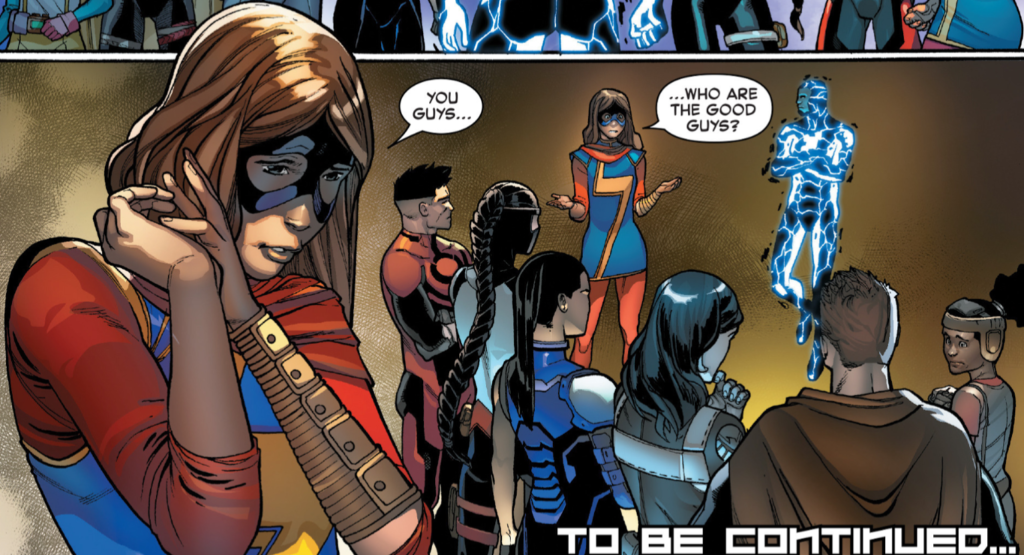
| I can answer that question, Ms Marvel, but you won't like it. |
And on that note, in Inhumans
Vs X-Men, the X-people have decided that in order to have enough time to
deal a second poison cloud, the Inhumans have to be put out of commission for a
while. So they lock the Inhumans in hell. And I’m pretty sure that this is what
Marvel thought was all that was necessary to convince us that the X-Men were
the baddies here. “Hell?” they seem to say “You know who lives in Hell? Satan
does and do you know what Satan is? A BADDIE!” to which the rest of the world,
who have just watched Lucifer says “Are
you sure? He seems rather charming and that’s without the ‘trying-not-to-die’ angle.” And Marvel then sticks
their fingers in their ears singing “LALALALALA”.
![]() |
| Oh, wow it's... you know what? I don't care. |
Now I’m someone who believes that event book should contain
all essential elements to the story in the event itself instead of in numerous
tie-ins. I believe this because I have limited funds like the rest of humanity
and my brain is still functioning. Marvel however, seem to think that most of
its audience have made it big on bitcoin. As a result, some key parts of the
story- parts that are essential to understanding what the hell is going on- are
relegated to tie-ins. As a result, the majority of this book left me wondering things
along the lines are “How did they know this?” “Where did these characters come
from?” “How many more pages before I take a bath with a toaster
oven?”
The art here is just good. It shows everything happening,
it’s just a pity that the things happening just aren’t very interesting. It
represents a missed opportunity for artists because the potential for awesome
panels in a book where the Inhumans and X-Men really go all out in combat, but
most of the book is either the Inhumans trying to get out of hell, or the X-Men
trying to figure out how not to die. I know people blame Civil War for being action-light, but it’s a roller-coaster
compared to this one.
Overall, this book is exactly what it sounded like when the
event was announced; a marketing ploy to direct us from one product to another.
It’s a shameless MCU advertisement designed to make us like the Inhumans more
than the X-Men. The problem? At the end of the day, you’re likely to hate the
Inhumans more that you ever did. It’s like every time Miley Cyrus is allowed in
a recording studio. It gets one out of five toaster-oven baths.
Subscribe to:
Posts (Atom)